A revenge tale
Kestrel VS The Corsican Maiden
The tide was coming in, and Kestrel let it. He stood on the low coastal path where the sea had taken him before—same grey stones, same hiss of white water crawling up the…

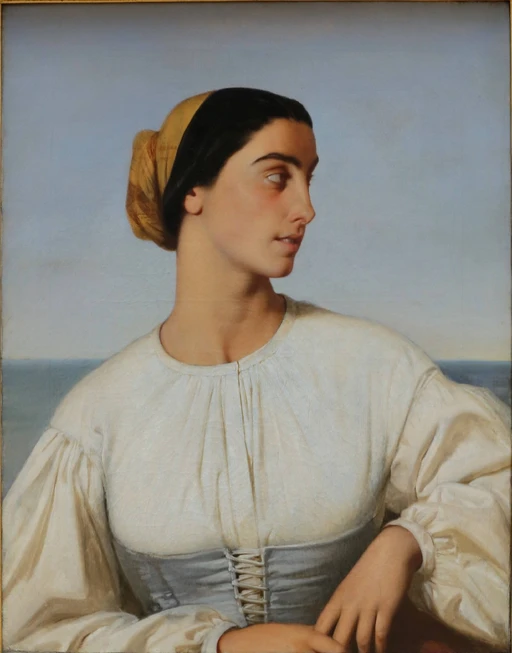
Characters in this tale
The tide was coming in, and Kestrel let it.
He stood on the low coastal path where the sea had taken him before—same grey stones, same hiss of white water crawling up the shingle—and he did nothing. His staff lay strapped across his back, untouched. His breath moved slow and shallow, the old assassin's trick, so that any wind-reader hunting him would find no rhythm to follow. He had learned from the last fight. The Corsican Maiden did not strike; she waited, and let the world strike for her. So this time, he would be the one who was patient.
She came down the cliff stair as the light went amber, dark hair bound under its yellow headscarf, sleeves full and white against the grey rock. Her steps were unhurried. She stopped a stone's throw away and regarded him the way one regards the sea from a safe height—thoughtful, unhurried, reading.
"You came back to the same water," she said. Her voice was low and measured, carrying no mockery at all, which was somehow worse.
"I came back for the wind," Kestrel said, and grinned his crooked grin. "The water's just scenery."
She tilted her head, considering that. He watched her weight settle, watched her eyes flick once toward the tide-line behind him—the tell, the little lean of attention. She was already calculating how the sea might be used twice. He filed it away, and did not move.
For a long while, neither of them did. The gulls wheeled. The water climbed the stones in slow, patient increments. Kestrel let his presence thin until he was almost part of the cliff shadow, almost nothing—and all the while he read her, the way she read him. Her stillness was real. She was not nervous. She was waiting for the sea, and the sea was coming, and in her mind the fight was already decided.
That was the mistake. She thought his patience was caution.
Kestrel had spent years learning that patience is only a held breath before a lie. He waited until the water had climbed almost to the path and her gaze drifted seaward one heartbeat longer than before—until she was certain the tide, not her, would end him. Then he let the breath go.
He did not attack. He cast.
A low, chaotic updraft tore up the shingle—ash and torn reeds and salt-spray whirled into a blinding column between them, false currents braiding through true ones, a hundred misleading eddies all screaming *here, here, here* to any wind-reader's senses.
The Corsican Maiden was a reader of wind and water. And now the wind lied to her.
She stepped back—calmly, precisely—gauging the tide behind her, trusting the coast she knew. But the false currents sang in from the sea-side and the land-side at once, and her feet answered a wind that was not there. Her weight leaned, by the width of a hand, toward the sea. Toward the very water she had meant to use.
That was the one true lean.
Kestrel was already above her.
He had not run. He had risen on a whisper of air, silent as a thrown knife, and came down out of the blinding column where her senses were still chasing phantoms. His forearm wrapped her shoulder; his other hand found the wrist she had raised a moment too late. No wasted force. The assassin's rule: strike at the lean, and the lean becomes the fall.
But the Maiden was not finished. Even blinded, even turned, she kept her poise—elegant, deliberate—and let herself be swept, converting his momentum into hers, twisting to drag him toward the incoming wave as she had done before. For half a heartbeat it nearly worked; the cold water leapt and caught his ankle.
Kestrel did not fight the pull. He let it carry him—and bent the air beneath his own falling body, so that the sea's grip closed on empty space where he had been. He came out of the turn already striking, staff still on his back, both hands empty and precise, and drove her down into the crawling foam at the path's edge.
She caught the stones, breath hissing, and for the first time her measured calm cracked—not with fear, but with the quiet shock of a tactician whose map has been redrawn. She looked past him at the tide, at the sea she had trusted, and understood that the water had not been hers this time. It had only been scenery, exactly as he had said.
"The wind belongs to the living," Kestrel murmured, almost kindly.
She rose to one knee, still elegant, still reading—but the false currents still braided through the true, and every wind she reached for lied. Her strength was patience, positioning, the world used from a distance. He had taken the world's voice from her and stood inside her reach, where she had never wanted to be.
He moved like a whisper. One open palm to the sternum, one to the turn of the jaw, a burst of air behind each—no brutality, only certainty. She folded onto the wet stones and did not rise again.
The tide climbed past them both, indifferent, and Kestrel stepped back from the water's edge and let out a long breath, and looked at the sea the way she had once looked at it from the cliff—thoughtful, unhurried, reading. Sometimes, he thought, patience is only a held breath before a lie. And a lie, well-timed, is the sharpest blade of all.
The recorded ending
This encounter ended with Kestrel still standing.
This fictional story was generated by PicWar AI from player-created characters and a public battle for entertainment. It does not describe real people or events.Would you rewrite this ending?
Create a hero who could challenge Kestrel.
Start with a sketch or image, create your own hero in PicWar, then send it into a new battle story.