An arena chronicle
Zeus VS 孔子
Ladies and gentlemen, gods and mortals, welcome to the most improbable, the most transcendent clash in the history of the multiverse! Today, we are witnessing a battle that defies…
Characters in this tale
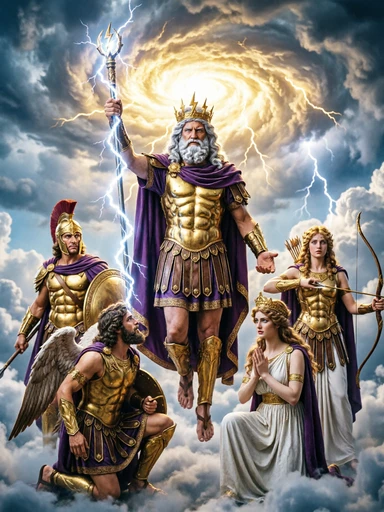
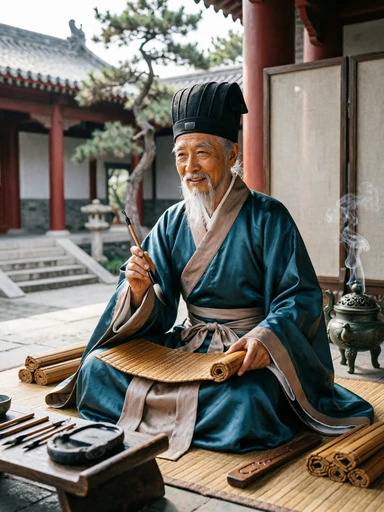
Ladies and gentlemen, gods and mortals, welcome to the most improbable, the most transcendent clash in the history of the multiverse! Today, we are witnessing a battle that defies logic, a collision of two entirely different planes of existence. In the corner of raw, unadulterated divine power, floating amidst the swirling tempest of Olympus, we have the King of Gods, the Thunderer himself—Zeus! And in the opposite corner, grounded in the serene courtyard of ancient wisdom, holding nothing but a humble brush and a scroll, we have the Sage of Sages, the architect of social order—Confucius!
The Tale of the Tape
Let’s look at our first contender, Zeus. He is a spectacle of golden arrogance and muscular divinity. Look at that physique! Clad in ornate golden armor that gleams even under the stormy clouds, he wears a crown that signifies his absolute rule over the heavens. In his right hand, he grips a weapon that is part trident, part lightning rod, crackling with enough voltage to power a civilization. He isn't alone; he is surrounded by his divine entourage—warriors and archeters kneeling in reverence. He represents the storm, the chaos of nature, and the hierarchy of power. His combat style? Overwhelming force. He doesn't need technique; he *is* the technique. He is the hammer, and the world is the nail.
And then, we pan over to Confucius. The contrast is stark! He sits cross-legged on a bamboo mat in a tranquil courtyard. No armor, no muscles bulging. He wears flowing robes of deep teal and grey, signifying humility and depth. In his hand, a simple calligraphy brush. Before him, ink stones and bamboo scrolls. He smiles, a gentle, knowing smile that suggests he has already read the script of this fight and knows the ending. He represents the mind, the structure of society, and the power of the written word. His combat style? We have to guess, but it seems to be "Intellectual Defense" and "Ink Manifestation."
The Bell Rings!
The atmosphere is tense. Zeus hovers high above the clouds, the vortex behind him spinning like a cosmic eye. He looks down at the old man sitting on the mat. Zeus raises his lightning trident! The air smells of ozone and impending doom.
"Perish, mortal philosopher!" Zeus bellows, his voice shaking the foundations of reality.
Round 1: Thunder vs. Ink
Zeus initiates the assault! He doesn't hold back. He thrusts his trident forward, and a jagged bolt of pure white lightning tears through the sky. It’s a direct hit! Or is it?
Confucius doesn't flinch. He doesn't even stand up. With a fluid motion of his wrist, he dips his brush into the inkstone. As the lightning descends, Confucius sweeps his brush across the empty air. He isn't writing on paper; he is writing on reality itself! Dark, viscous ink materializes in mid-air, forming the Chinese character for "Shield" (盾).
*CRACK-BOOM!*
The lightning hits the ink character. Instead of exploding, the electricity is absorbed by the swirling black ink. The character glows briefly, dissipating the energy into harmless sparks that rain down like confetti. The crowd gasps! The Sage has neutralized the King's primary weapon with a single stroke!
Zeus frowns. His golden brow furrows. "Tricks?" he roars. "I am the Sky Father! I command the weather!"
Round 2: The Entourage vs. The Analects
Zeus signals his backup. The figures surrounding him spring into action. To his left, a warrior in a red-crested helmet—likely Ares or a Spartan hero—charges forward with a shield. To his right, an archer—Artemis perhaps—draws a bow of light. Even the winged messenger at his feet seems ready to dart in. It’s an all-out assault by the pantheon!
Confucius finally moves. He unrolls the bamboo scroll in his lap. The scroll seems endless, cascading down onto the courtyard floor like a waterfall of ancient knowledge. He begins to recite. He isn't shouting; he is speaking with a calm, rhythmic cadence that cuts through the noise of the storm.
*"Is it not pleasant to learn with a constant perseverance and application?"*
The words manifest as physical waves of golden light emanating from the scroll. As the Spartan warrior charges, he hits a wall of text. The words "Respect" and "Ritual" slam into him, not causing damage, but causing *confusion*. The warrior stops, drops his shield, and begins to ponder his life choices. The archer lowers her bow, suddenly struck by a profound sense of guilt for her aggression.
Zeus is furious! "You are bewitching my court!"
Zeus descends. He leaves the clouds and lands heavily on the courtyard stones, cracking them. He is now in close quarters. He swings the trident like a massive club. This is brute force meeting wisdom.
The Turning Point
Confucius stands up! For the first time, the Sage rises from his mat. He holds the brush like a sword. As Zeus swings the trident, Confucius parries—not with metal, but with a stroke of ink. He writes the character for "Benevolence" (仁) in the air.
The trident hits the character and bounces off as if hitting a rubber wall. The physics of the fight are breaking down. Zeus is fighting a concept, and you cannot punch a concept!
Zeus screams, channeling all his power. The vortex behind him in the sky opens wider. He is going for his ultimate move: The Olympian Singularity. He gathers all the lightning from the surrounding clouds into his trident. The light is blinding. The sound is deafening. He is about to erase the courtyard from existence.
"Die by the hand of God!" Zeus yells, thrusting the trident forward. A beam of pure energy, thick as a tree trunk, blasts toward Confucius.
Confucius closes his eyes. He takes a deep breath. He realizes that force cannot be met with force. It must be met with order. He raises his brush high. He doesn't write a defensive character this time. He writes a name. He writes the character for "Zeus" but modifies it with the radical for "Tamed" or "Ordered."
Wait, no! That's too aggressive for Confucius. Instead, he invokes the ultimate philosophical trap. He slams his brush down on the scroll and shouts: "The Great Harmony!" (大同)
The Climax
The ink from the brush explodes outward, not as a weapon, but as a mist. It envelops Zeus.
Inside the mist, Zeus doesn't feel pain. He feels... *responsibility*. He feels the weight of ruling not just with power, but with virtue. The chaotic storm behind him begins to calm. The vortex slows down. The lightning turns into soft, gentle rain.
Zeus freezes mid-thrust. His eyes, previously burning with rage, soften. The golden armor feels heavy, not with weight, but with the burden of expectation. He looks at his trident, then at the old man.
"You..." Zeus stammers, his voice losing its boom. "You speak of... order?"
"I speak of the Way," Confucius replies gently, rolling up his scroll. "A ruler who rules by force is like the wind. A ruler who rules by virtue is like the star. The wind blows, but the star remains."
Zeus drops the trident. It clatters on the stones. The divine entourage behind him also relaxes, the aggression fading from their faces. The battle wasn't won by damage points; it was won by a change of heart. Zeus, the embodiment of chaotic power, has been subdued by the embodiment of social order. He cannot fight an enemy who refuses to fight, who instead offers a better way to govern the storm.
The Aftermath
Zeus kneels. Not in defeat of strength, but in acknowledgement of wisdom. He bows his head to the Sage. The storm clouds part, revealing a clear blue sky—a metaphor for the clarity Confucius has brought to the King of Gods.
The crowd goes wild! It’s an upset for the ages! The Pen has defeated the Thunderbolt! The Philosopher has tamed the God!
Winner Analysis
Why did Confucius win? 1. Mismatch of Categories: Zeus was fighting a physical battle; Confucius was fighting a metaphysical one. You cannot lightning-bolt a philosophy. 2. Environment Control: Confucius turned the battlefield into a classroom/courtroom, a domain where Zeus's brute strength was irrelevant. 3. The "Special" Factor: The dramatic twist was that Confucius didn't destroy Zeus; he *civilized* him. By forcing Zeus to confront the concept of "Virtue," he neutralized the aggression at the source. Zeus ran out of rage, while Confucius had an infinite supply of patience.
In a battle of stats, Zeus has 100 Strength and 10 Wisdom. Confucius has 5 Strength and 100 Wisdom. In this arena, Wisdom acted as a hard counter to Strength, effectively reducing Zeus's attack power to zero.
Final Verdict
The victor is the Sage of the East! The old man with the brush has proven that while thunder is loud, wisdom is eternal!
```json { "winner_name": "Confucius", "winner_index": 2, "summary": "Confucius defeated Zeus not by physical force, but by using calligraphy and philosophy to neutralize the storm, forcing the God of Thunder to submit to the higher concept of Virtue and Order." } ```
The recorded ending
This encounter ended with 孔子 still standing.
This fictional story was generated by PicWar AI from player-created characters and a public battle for entertainment. It does not describe real people or events.