A revenge tale
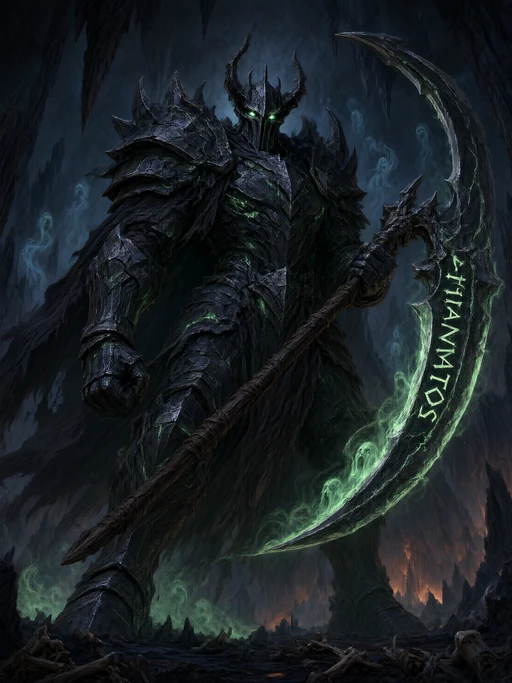
Kerberos VS Knight Don Quxote
Dust hung in the air like a held breath, and the plain had already begun to lie. Kerberos felt it before seeing it—the ground beneath three sets of paws turning treacherous, the…

Characters in this tale
Dust hung in the air like a held breath, and the plain had already begun to lie.
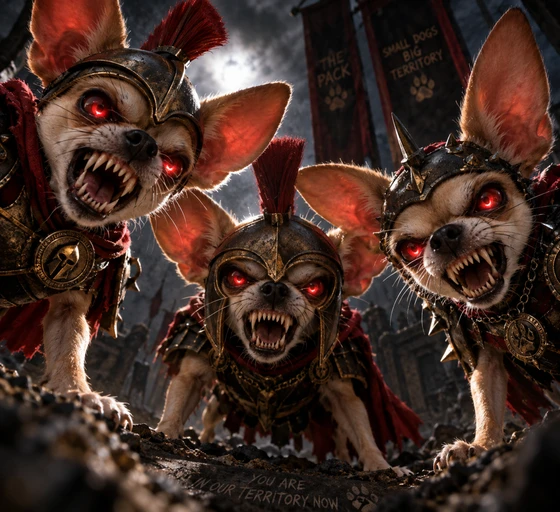
Kerberos felt it before seeing it—the ground beneath three sets of paws turning treacherous, the horizon folding in on itself where the Knight Don Quxote's codex-light bled through the heat haze. The first of the three had been the Anchor, Tucker, and the Knight's lance had found him once before, splitting the Pack's shared network at its root. That wound was memory now, stitched into the blood. They would not gather on one patch of ground again.
So they split—not scattered, not fleeing, but *divided by design*. Tucker took the low stone shelf to the east. Ajax circled wide through the brush, silent, low to the earth. And Kerberos, the Tracker, ran the open middle, eyes burning red beneath the crimson crest of a Roman helm, watching the Knight come.
Don Quxote rode as he always rode: upright, unbroken, the cream cloak snapping behind him like a banner of some older kingdom. He saw the three small shapes break apart across the plain and did not slow. In his mind this was mercy's arithmetic—divide the beast, and the beast cannot bite. His lance, held level, hummed with the Codex's conviction: *what is ideal is harder than what is real.* Illusion would not turn it. Distance would not tire it. He had broken the Pack once. He would break it cleanly again.
He chose the middle. He always chose the middle.
The horse's hooves struck the earth and the earth answered falsely—no, that was Kerberos's own doing, a low growl rolling across the ground like water finding cracks. The Pack did not need a shared network to hunt. Each body anchored itself: three separate laws of territory, three separate claims, laid down in a wide, deliberate triangle. Wherever the Knight turned, he would be entering *someone's* land.
Don Quxote lowered the lance and drove forward. He did not aim at all three, because he could not—he aimed at the one that moved, the Tracker, the nearest red-eyed shape in the dust. A clean line. A single, decisive thrust.
Kerberos did not meet it. He *withdrew*—one step, two, angling not away but sideways, dragging the Knight's chosen line across ground that belonged to Ajax. The Knight's horse, committed to the gallop, could not refuse the path. Its momentum carried it through the triangle's western edge, and Ajax was already there, low, teeth bared, not attacking but *occupying*—planting a claim on the exact strip of earth the horse's next stride required.
The Knight felt it. A knight of his discipline felt everything. He hauled the reins, broke the charge, wheeled—and Tucker had already closed the eastern shelf behind him, a small armored shape standing in the one gap through which a horseman could regain speed.
Three bodies. No shared signal. No shout, no order, no command. Just three separate hungers converging on the same truth: *the Knight cannot be everywhere, but the Pack can stand everywhere at once.*
Don Quxote understood then what had changed. Last time he had killed the Anchor and the whole structure had fallen. This time there was no single Anchor to kill. Each dog was its own root. To break the Pack, he would have to break all three, and to reach any one of them he would have to cross ground held by the other two.
He raised the lance skyward, and the Codex answered—light gathering along the shaft, the ideal made hard, indifferent to the false horizons Kerberos kept folding across the plain. He would not chase. He would ride *through*. Straight at the Tracker, through every illusion, because an ideal does not flinch at a mirage.
And Kerberos, watching the light gather, did the one thing the Knight had not prepared for. He stopped moving.
The other two stopped as well—Tucker, Ajax, all three going still at once, heads lowered, a low synchronized growl rising from three throats into one continuous sound. Not a formation. Not a wall. A *convergence*. The Knight's line, drawn from his lance to the Tracker, passed through no gap—because the Pack had removed the gap. Where the charge must land, a body already stood. Where the horse must turn, a body already stood. The terrain itself had become the Pack, and the Pack had become the terrain.
Don Quxote drove the lance forward with all the conviction of his order, and it struck true—struck the ground where Kerberos had been, a heartbeat before the Tracker slid aside along the line of his own shadow.
The horse could not stop. The Codex-light spent itself into empty earth. And in that spent instant, the triangle closed.
Tucker took the left foreleg's ground. Ajax took the rear. Kerberos took the space before the horse's chest—not striking, not leaping, simply *being there*, red eyes level, teeth showing, occupying the exact point the animal's panic would drive it toward. The horse reared. The Knight, thrown against his own momentum, fought the reins and lost the rhythm of the charge. A knight without his charge is a man in heavy silver, standing in three territories at once, belonging to none.
The Pack did not bite. It did not need to. It had done what it was built to do: it had taken the Knight's path away from him and left him standing where he could not move, could not build speed, could not choose a single target without turning his back on the other two.
Don Quxote sat his rearing horse in the ring of red-eyed stillness, lance lowered now, breath heavy inside the helm, and for the first time since he had ridden onto this plain he did not know which way to charge. The Codex was hard. The ideal was hard. But hardness means nothing when there is nowhere left to point it.
Kerberos stepped forward one pace, and the triangle tightened by that single pace. Tucker matched it. Ajax matched it. The three claims closed like a hand.
The Knight's lance dipped. He had come to break the Pack, and the Pack had become the ground beneath him—three small dogs, three separate anchors, one hunt, and no single body left for him to erase.
The plain went quiet. The dust settled. And the territory, at last, was theirs.
The recorded ending
This encounter ended with Kerberos still standing.
This fictional story was generated by PicWar AI from player-created characters and a public battle for entertainment. It does not describe real people or events.Would you rewrite this ending?
Create a hero who could challenge Kerberos.
Start with a sketch or image, create your own hero in PicWar, then send it into a new battle story.