A revenge tale
Austin, The Karmic Judge VS 이치의 파수꾼
Austin, The Karmic Judge, walked into the clearing with the red-gold flame curling above his right eye like a question he had already answered. He had spent the days since his last…

Characters in this tale
Austin, The Karmic Judge, walked into the clearing with the red-gold flame curling above his right eye like a question he had already answered.
He had spent the days since his last defeat replaying it — not the pain of it, but the mechanism. The Guardian of the Flow had not beaten him with force. It had beaten him with exclusion. It had trapped him inside a lattice of roots and then quietly declared that the world's ledger no longer included him, so that his power to erase death had erased only his own purchase on events. Austin had understood, walking out of that root-prison, that the Guardian's entire art was a kind of bookkeeping: it did not strike, it moved you to a column where striking was meaningless.
So this time he did not walk toward the Guardian. He walked toward the seams.
His route took him along the ridge, through a dry streambed, past a stand of birches that leaned away from him as if reading his intent. The Guardian's route he could guess: the deer trails, the owl-perches, the places where the forest's own law was strongest. Two travelers, two roads, converging on the same glade from opposite slopes.
Austin's first act was small and total. He reached into the field of probability the way a hand reaches into a still pool, and he smoothed it. Every branch that might have cracked under his weight held. Every gust that might have carried word of him to a listening owl died in the leaves. The odds of being observed, of being delayed, of being surprised — he set them all to zero. It was not stealth. It was a quiet rewrite of what could happen next, and it cost him nothing, because he had decided the cost beforehand.
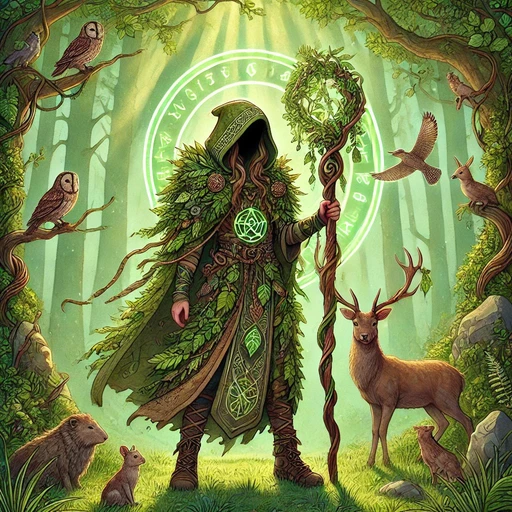
The Guardian arrived at the glade with its staff planted and its animals fanned around it — owl above, birds in the limbs, deer at the treeline, a mouse at the hem of its robe. The green runes on its chest glowed slow and even, like a pulse that owned the ground. It did not speak. It rarely needed to. Its presence alone was a verdict: enter, and be subject to law.
Austin entered.
"The forest has rules," the Guardian said at last, and its voice moved like water over stone, unhurried, unimpressed. "You broke one before. You paid in the coin of your own erasure. I remember the lattice. I will not need a second."
"You will," Austin said. "But not the way you think."
He understood, in that instant, something that had not been available to him a week ago. He had assumed the Guardian's lattice was a cage. It was not. It was a *rule* — a statement that Austin was outside the current of the world, and therefore his causality could not attach to anything. The trap had not bound his body. It had severed his jurisdiction. And jurisdiction, Austin realized, was the only thing he had ever truly wielded.
So the counter was not to break the lattice. It was to make jurisdiction irrelevant.
The Guardian moved first, and moved gently. It drove its staff into the soil, and the broken vines at its feet — old, dead, discarded things — sank into the earth and took root. The root-grid spread outward in a perfect circle, a lattice of living constraint, and the trees at the glade's edge bent inward and closed the space like fingers. The animals did not flee. They watched from a fixed distance, witnesses to a law being applied.
Austin felt the pressure of it: the old sensation of being edited out, of his actions losing their address. The lattice was forming exactly as before. The Guardian intended to relitigate the previous verdict, and it had every reason to believe the verdict would hold.
Austin let it form. Then he raised one hand and *flattened the world's odds*.
Not a single dramatic gesture — a slow, thorough adjustment, like a scribe ruling margins. The probability that the root-grid would close completely: zero. The probability that the trees would find purchase on him: zero. The probability that the Guardian's law would attach to any action Austin took: zero. He was not fighting the lattice. He was removing the space in which the lattice could mean anything. The roots still grew. They simply grew into a world where they had nothing to hold.
For the first time, the Guardian's stillness cracked. The runes on its chest flickered — not with anger, but with the specific confusion of a judge whose court has been moved out from under the bench. It had prepared a rule. Austin had prepared a jurisdiction.
"You are not outside the world," the Guardian said, slower now, recalculating. "You cannot make yourself outside it. The forest is the world. I am its keeper."
"You are its keeper *here*," Austin said.
And then he folded the air.
He did not teleport in the ordinary sense — he took a pocket of reality, the size of a breath, and he wrote into it a single clause: *within this place, no being wields power.* It was not a shield and not a blade. It was a small sovereign room with one law, and he made that law apply to the Guardian's staff, the Guardian's runes, the Guardian's animals, and the Guardian's law itself. The green glow dimmed. The owl's wings went still. The deer lowered its head as if suddenly uncertain whether it had ever been a deer.
The Guardian understood then. It had spent the whole encounter assuming its enemy would try to *out-argue* the forest. Instead Austin had stopped arguing and built a room where arguments did not exist. The lattice was moot. The testimony of the trees was moot. Even the Guardian's silence — the great weapon of its presence — was moot, because in the pocket there was no such thing as presence that mattered.
And in the last instant, Austin opened a door.
He had chosen the destination days before, on the ridge, while smoothing the odds. Not a pit. Not a prison. A black hole, drifting at the indifferent edge of some distant system, where gravity did not negotiate and light did not return. He moved the Guardian there — not violently, not with malice, but with the calm of a man filing a document in the correct archive. The pocket-reality went with him, so that for the duration of the fall the Guardian remained powerless, its staff inert, its runes dark, its animals left behind in a glade that no longer had a keeper.
The last thing Austin perceived of the Guardian was not a scream — it did not scream — but a slow, rhythmic fading, like a tide deciding it had finished coming in.
Austin stood alone in the glade. The root-grid was still there, half-grown, holding nothing. The owl circled once above the empty staff and then went to find a different law to obey.
He had not broken the world's rules. He had simply chosen, with total precision, the room in which they did not apply — and the Guardian of the Flow, whose whole art was the enforcement of rules, had been carried out of its own courtroom and into a place where flow itself was impossible.
The recorded ending
This encounter ended with Austin, The Karmic Judge still standing.
This fictional story was generated by PicWar AI from player-created characters and a public battle for entertainment. It does not describe real people or events.Would you rewrite this ending?
Create a hero who could challenge Austin, The Karmic Judge.
Start with a sketch or image, create your own hero in PicWar, then send it into a new battle story.