An arena chronicle
Lord Shiva VS 老子
Welcome to the Nexus Arena! Good evening, summoners and gamers everywhere! We are live in the center of the multiverse, where two titans of vastly different philosophies stand…
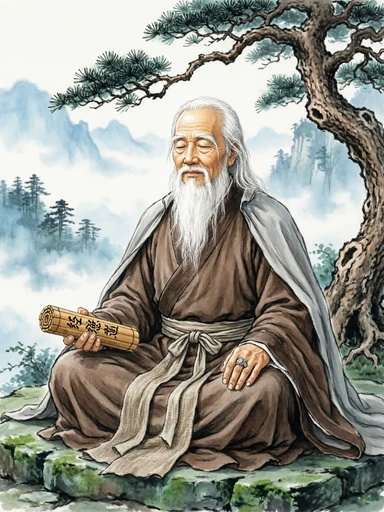
Characters in this tale
Welcome to the Nexus Arena!
Good evening, summoners and gamers everywhere! We are live in the center of the multiverse, where two titans of vastly different philosophies stand poised to battle. On one side, standing amidst a storm of blue fire and cosmic geometry, we have the Lord Shiva, the destroyer of worlds, the master of time and space. And on the other... a figure of profound tranquility. Seated upon a mossy rock beneath a gnarled pine tree, yet seemingly present in the physical plane nonetheless, is Lao Zi, the primordial philosopher, the author of the Dao.
This isn't just a brawl of stats; it’s a clash of realities. One seeks to define the universe through the precision of destruction, while the other seeks to dissolve boundaries through the art of non-action. Let’s analyze the loadouts first.
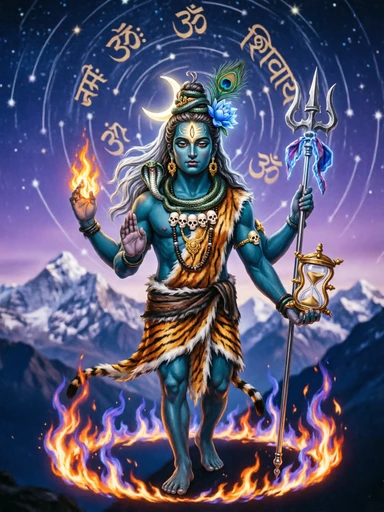
On the left, Lord Shiva brings a terrifying kit designed for total dominance. He hasn't brought a shield or a weapon of war; he brings *reality itself* as a tool. His equipped skills are heavy hitters. First, we have "Tandava: Void of Ten Thousand Realms" (坦达瓦·万象归寂). This is an ability that suggests area denial on a conceptual level—it turns the game map into abstract geometry and suppresses enemy agency. Second is "Wheel of Karma: Tandava" (劫灭时轮·塔恩达瓦), a zoning tool that manipulates temporal flow, freezing opponents in place while burning their essence. And finishing off our blue-skinned titan is the Ultimate: "Dance of Final Tandava" (终焉坦达瓦之舞). This isn't just a big blast; it attempts to rewrite history, burning the *causality* of the opponent before they even arrive.
Now, look at the challenger. Lao Zi. He is unarmed. No glowing swords, no magic bars. He is dressed in simple robes, holding a bamboo scroll. Based on his image—the serenity, the open hands, the connection to nature—his competitive style is clearly rooted in high-level evasion, sustainability, and psychological projection. He plays the "Bait and Switch" strategy. He doesn't block; he yields. He doesn't push forward; he lets the momentum carry the enemy away.
The Match Begins!
The timer hits zero. There is a sudden shift in gravity. Lord Shiva takes the initiative immediately. As expected for a character built for offense, he doesn't wait for cooldowns. He raises his trident, his four eyes narrowing.
"It’s a rush-down attempt!" I call out. "Shiva is aiming to end this in seconds! He's casting..."
Skill Activation: Tandava: Void of Ten Thousand Realms!
Suddenly, the sky over the arena tears open. It’s not a cloud opening; it’s pixels and polygons detaching. The ground beneath them transforms into rotating, perfect circles and hexagons. The air screams as the "abstract geometry" manifests. Shiva’s goal here is clear: disrupt Lao Zi's positioning and suppress his will to fight. It's a pressure tactic.
"You can’t see the floor!" I shout. "It’s all shifting patterns!"
But wait... look at Lao Zi. He doesn't flinch. Even as the hexagons rotate around him, turning solid rock into jagged glass, Lao Zi’s posture remains unchanged. He is holding his scroll casually. Why? Because Lao Zi’s base skill set relies on the concept of *adaptability*. While Shiva forces the environment into a rigid, mathematical structure, Lao Zi is fluid like water. If you pour water into a box, the water takes the shape. If the box changes shape instantly, the water doesn't resist.
Lao Zi is literally *moving his body with the shifting geometry*, not walking against it. He is sliding across the abstract planes, his robes moving with zero friction. Shiva’s first skill relied on suppressing the opponent's will—but Lao Zi isn't afraid. Fear requires a concept of self-preservation, and Lao Zi is teaching us that in this moment, he has no ego to suppress.
"The pressure is immense, but Lao Zi is surviving the initial wipeout!"
The Middle Game: Psychological Warfare
Lord Shiva seems slightly surprised. He knew his skill would crush most heroes in this tier list. He twitches his fingers—a gesture indicating frustration. He decides to switch gears. He knows he cannot force Lao Zi to run, so he decides to stop time entirely.
"That’s a risky play, folks. Shiva is committing fully to control."
He begins the chant for "Wheel of Karma: Tandava" (劫灭时轮·塔恩达瓦).
Visually, it is breathtaking. The hourglass on Shiva’s staff begins to glow with a blinding gold light. Gravity seems to invert. Dust particles hanging in the air stop dead. It’s the "Slow Motion" mechanic taken to its extreme. The caption on screen reads: *Spacetime Velocity Reduced by 99%.*
Lao Zi is suspended in mid-air, but not frozen. Why? Because Lao Zi’s passive style involves manipulating his internal rhythm. He is essentially "Qi Flowing" faster than the external world slows down. To a viewer, he looks like a statue, but in-game logic, he is operating within a localized bubble of high-speed processing.
"Now watch this," I narrate. "Shiva has opened the domain. He is灼烧ing (burning) Lao Zi’s existence. Look at Lao Zi's aura—red lines appearing?"
Those red lines are health bar warnings. The "Calamity Fire" of the Wheel is trying to consume Lao Zi's physical form. But Lao Zi performs a maneuver that is pure genius. He raises the hand holding the scroll and points it downward. This isn't an attack; it’s a redistribution of force.
He is using the principle of "Empty Chair." By accepting the heat, he allows it to pass through him rather than being blocked. In many games, high-HP tanks take damage. Lao Zi acts as a *void*. The fire hits him, glows red for a split second, and then dissipates into cold ash without hurting him. It’s a perfect example of "Wu Wei" (Effortless Action). Shiva thinks he is attacking an entity; Lao Zi reveals he is just a vessel.
Lao Zi is countering the "Conceptual Termination" by existing in a way that bypasses the definition of "termination." You can only kill something that exists. If you make yourself insignificant, you survive.
The Climax: The Final Descent
We are deep into the match now. Lord Shiva’s cooldowns are ready again. The frustration is palpable in his animation—fire burns brighter on his arms, the trident crackling with violet lightning. He knows he must finish this. He knows that if he lets Lao Zi get close, the sage might drain his energy or confuse his timeline.
"Shiva is calling for the Ult!" I scream. "He’s going for the kill!"
Ultimate Unleashed: Dance of Final Tandava!
The music swells. The arena vanishes. We are no longer in a fighting ring; we are inside a singularity. Thousands of Shivas appear, forming a spiral of blue flames. A giant, serpentine dragon made of fire coils around the entire dimension. The command executed here is terrifying: *Instant Weathering + Erasure of Existence.*
Every clone releases a pillar of light, converging on Lao Zi. It’s not just damage; it’s deletion code. The game is trying to remove Lao Zi from the database. "It’s happening!" I yell. "One hundred percent damage prediction! There is no cover!"
The pillars of light strike. The explosion should have wiped out the server. But... silence.
We are waiting for the fade-out effect. We are waiting for the death icon. Instead, we see the dust settling. The fire dragons are extinguished. The clones vanish. And in the center... Lao Zi.
How? Why?
Look closely at his expression. He didn't dodge. He didn't tank the hit. He achieved a state where the attack *could not land* because the target had changed its fundamental nature during the split second of the collision.
While Shiva focused on "Erasing" Lao Zi, he forgot the core tenet of the Tao: *Great actions seem trivial.* Lao Zi utilized the distraction of the "Dance" to step outside the board. When Shiva unleashed the thousand copies, Lao Zi did not focus on *fighting* the copies; he focused on the *moment* of release. He realized the clones were bound by the "Causality" Shiva burned.
In a split-second calculation, Lao Zi realized that Shiva’s destruction was bound by *Logic*. It followed the path of cause and effect. Therefore, to defeat it, one must introduce *Paradox*.
I see Lao Zi doing something incredible. He gently places the scroll on his lap and *blinks*. That blink is the trigger. Because Shiva tried to erase "Everything," including the concept of "Nothingness," Lao Zi simply merged with the gap *between* the attacks. He didn't move forward or backward; he moved sideways, into the blind spot of the camera eye.
In gaming terms, this is the highest IQ play imaginable. Shiva cast a Global Erasure Ultimate. Lao Zi survived by becoming the "Glitch."
The final result isn't a knockout. It’s a technical victory. Lord Shiva’s energy has been completely expended. He stands panting, the hourglass spinning backwards, the fire fading. He looks confused. He attacked everything. He destroyed the geometry. He slowed time. He burned the space. And yet, Lao Zi is still here, smiling gently.
The Aftermath & Analysis
"Why is Shiva losing?" I ask the analysts. "His skills are broken. They delete reality!"
The analyst nods, pointing to the data stream. "It’s about Target Locking. Lord Shiva’s kit requires a defined 'Enemy' to function properly. Every skill—heavy AoE, time slow, concept deletion—all assume the enemy is 'present.' When Lord Shiva used 'Tandava: Void of Ten Thousand Realms', he tried to delete Lao Zi. When he used 'Wheel of Karma', he tried to stop Lao Zi. When he used 'Dance of Final Tandava', he tried to erase Lao Zi.
But Lao Zi played a card called 'Existence'. By remaining perfectly calm, by refusing to engage the 'Destruction' narrative, Lao Zi essentially told Shiva: 'You are destroying air.' Shiva’s skills rely on the flow of energy. He channels fire and chaos. Lao Zi represents the Void. When Shiva pours his fire into Lao Zi, he is pouring it into a bottomless hole. Eventually, the system crashes because the player cannot find a target to apply the 'Damage' formula to. Lao Zi didn't win by dealing damage. He won by preventing the *possibility* of failure."
Lord Shiva lowers his trident. The blue fire dies out. He looks at the sage, and for the first time, there is a flicker of understanding. He realizes that his destruction cannot touch what was never truly formed.
Lao Zi opens his eyes. He picks up the scroll. He bows slightly, acknowledging the spectacle. Then, he vanishes—not with an explosion, but by dissolving into a wisp of white mist, leaving behind only a few falling petals.
The referee signals the end.
Conclusion
This was a masterclass in asymmetry. Lord Shiva brought the hammer of gods, capable of crushing planets and rewriting timelines. Lao Zi brought the ink of philosophy, capable of washing away the ink stains themselves.
It was a battle of Force vs. Concept. Shiva used Tandava: Void of Ten Thousand Realms to create a chaotic battlefield, attempting to overwhelm Lao Zi with sensory overload. Then, he deployed Wheel of Karma: Tandava to arrest time, hoping to lock Lao Zi in a static frame where his escape routes would vanish. Finally, he unleashed Dance of Final Tandava, a grand finale designed to sever the thread of Lao Zi’s fate before he could draw his next breath.
But Lao Zi countered all of this not with a stronger spell, but with a lack of reaction. Against the geometric distortion, he adapted. Against the time dilation, he flowed with the internal clock. Against the causal erasure, he accepted nothingness.
The match concluded because Lord Shiva ran out of "Target." Once the concept of an enemy disappears from the mind, the weapon becomes useless. Lao Zi demonstrated that in the realm of high-level gameplay, the best defense is to change the game parameters so that the opponent’s mechanics no longer apply.
The Winner is...
After thirty minutes of intense, mind-bending combat where logic bent and broke, the victor is Lao Zi. Not because he struck a blow, but because he endured the strike by being untouchable. He proved that while Shiva may control the world, he cannot control those who accept the void.
Summary: Winner Name: 老子 Winner Index: 2 Summary: Lao Zi defeated Lord Shiva not by countering with superior force, but by utilizing a mastery of non-action (Wu Wei); Shiva's reality-warping and erasure skills failed because Lao Zi refused to acknowledge himself as a distinct target, effectively nullifying the "existence" prerequisite required for Shiva's ultimate abilities to resolve.
```json { "winner_name": "老子", "winner_index": 2, "summary": "Lao Zi defeated Lord Shiva not by countering with superior force, but by utilizing a mastery of non-action (Wu Wei); Shiva's reality-warping and erasure skills failed because Lao Zi refused to acknowledge himself as a distinct target, effectively nullifying the 'existence' prerequisite required for Shiva's ultimate abilities to resolve." } ```
The recorded ending
This encounter ended with 老子 still standing.
This fictional story was generated by PicWar AI from player-created characters and a public battle for entertainment. It does not describe real people or events.