An arena chronicle
Kaji Fumisuru VS Eric, the bookkeeper
Kaji Fumisuru came up through the undercity, where the brickwork sweated and the lamps guttered low, and he did not hurry. Rushing was for men who still believed the world owed…

Characters in this tale
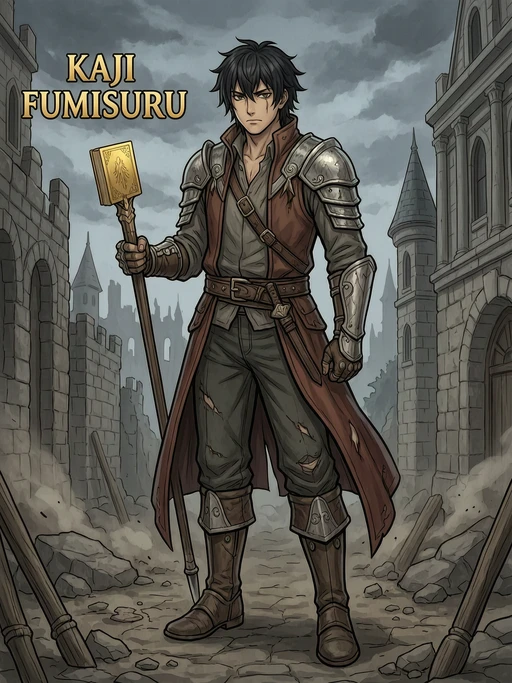
Kaji Fumisuru came up through the undercity, where the brickwork sweated and the lamps guttered low, and he did not hurry. Rushing was for men who still believed the world owed them a fair chance. He had learned better in a gutter at the age of nine, and he carried that lesson the way other men carried a name.
His route ran along the old aqueduct, then down through the flooded stacks beneath the archive district—channels that stank of ink and rot, where rats the size of boots watched him pass with proprietary contempt. He moved the way he always moved: low center of gravity, weight forward, the golden book-staff ticking against stone with every step. The book glowed faintly through its leather, a warmth like a pulse in his right palm. Whatever had been promised to him beneath the world, it had not promised mercy. He had stopped asking for it.
Above ground, the great library rose like a mountain built by patience instead of hands. And within it, Eric, the bookkeeper, walked his aisles at an unhurried pace, adjusting the float of a drifting volume here, smoothing a crooked line of projected ink there. The dragons that coiled across the reading hall were his; so were the spectral birds that nested in the high vault and the girl in the red hood who sat at the foot of a lectern, waiting for a page she would never reach.
Eric tilted his head, glasses catching the lamplight, and said to no one in particular, "The undercity route. Chapter nineteen, paragraph four. The revenant arrives on schedule."
Kaji heard him before he saw him—a voice like a librarian speaking over the shoulder of a sleeping reader.
He came up the spiral stair with the book-staff angled across his chest, coat hanging sodden, and took the measure of the room in a single sweep. Exits: three. Cover: the lecterns, the stacks, the falling books that did not fall. Enemies: one, mild-mannered, arms folded, wearing a gold pen like a badge of office.
"You wrote me arriving," Kaji said. His voice was gravel dragged over gravel. "That means you've been reading me."
"I catalogue what passes through," Eric said. "You are a difficult document. Torn pages, blood in the margins. I had hoped to correct it before you reached the reading room."
"Correct it."
"Return it to the trajectory it was meant to hold." Eric uncrossed his arms. "You were meant to die in the gutter, Kaji Fumisuru. I am not the one who spared you. But I am the one who notices when a story goes wrong—and I am the one who binds it shut."
Kaji's answer was not words. He crossed the floor in three strides, street-thief fluid, and brought the golden staff down in a short arc aimed at the scholar's collarbone. There was nothing ceremonial in it. It was the same motion he had used to crack skulls for bread money.
The staff stopped. Not against flesh—against air that had learned to hold its shape. A lattice of floating text flowered between them, an ink-wash paragraph peeled off a passing book, and it took the blow like a page taking a stain. Kaji withdrew a half-step, tested the barrier with a feint, found it unyielding, and did not waste a second strike on it.
"Discipline," Eric observed. "You have learned not to repeat a mistake. That is a good trait in a protagonist. It will not save you."
He raised one hand, and the library replied. Debris rose from every corner—torn covers, splintered lectern legs, the cast-off dust of a thousand years—and gathered into a slow current of drifting letters. The letters arranged themselves into a sentence Kaji could not read but could feel: a sentence about a man who stopped moving. It wrapped around his ankles. His arms grew heavy. The warmth in the staff pulsed hard against his palm, warning him, and he understood in one cold instant that the bookkeeper was not fighting him. He was editing him.
Kaji had never been edited. He had been burned through the gut and kept walking. He had been buried in debt and dug himself out with both hands. The pact that had given him the staff had offered him nothing but continuation, and continuation was the only thing he had ever been good at.
He did not try to tear the binding current apart. He stopped resisting the story entirely—let the sentences sink into him, let them describe a man who was ending, and then refused, from the center of himself, to be that man.
The current curdled. The letters lost their grammar. Wet ink ran down his coat, and the binding shattered into loose syllables that scattered across the floor like startled birds. Eric frowned for the first time, and adjusted his glasses.
"The Unedited Endurance," he murmured. "You are the life that could not be written over. I have catalogued a great many stubborn things. Not one of you."
"Then catalog this."
Kaji surged forward. He did not strike at the barrier this time—he struck at the books feeding it. The golden staff swept low and shattered the spine of a floating volume before it could project its ink-wash dragon; the beast dissolved unfinished, half-formed wings collapsing into a wet smear across the tiles. He was inside the scholar's reach before Eric could assemble a second sentence, close quarters where stories were short and debts were paid in blood. The staff butt drove into Eric's ribs. The staff head came back around, and the bookkeeper caught it with both hands, and for a heartbeat they stood locked—a scholar and a revenant, breathing hard, the gold light of the book crawling up Eric's wrists like a fever.
"You are exhausted," Eric said, calm even now. "Your trajectory ends here. It always ended here."
"Trajectories," Kaji rasped, "are for men who get to finish."
He twisted the staff. The golden book opened under Eric's grip, and what poured out of it was not light but debt—the weight of every year Kaji had survived when he should not have, every body that had stood between him and the grave, every promise made to him by a voice in the dark. He drove that weight forward, and the scholarly sentences that composed Eric's authority—his paragraphs, his corrections, his tidy arcs—could not hold a thing so ungoverned. The pages tore. The girl in the red hood scattered into loose type. The spectral birds broke apart mid-flight and fell as ash.
Eric staggered back against the lectern, one hand to his side, the gold pen fallen from his pocket and rolling across the floor. He looked up at Kaji without fear, only a faint, scholarly disappointment, as though reading a final line he had not authored.
"You were never meant to reach this page," he said.
"Neither was I meant to live past nine." Kaji stood over him, staff planted, breath ragged, coat dripping black ink. "I stopped owing the story a long time ago."
He did not strike again. The library had already stopped fighting for its keeper. The floating books settled, one by one, into silence, and the shadows in the high vault drew close and closed like a volume.
The recorded ending
This encounter ended with Kaji Fumisuru still standing.
This fictional story was generated by PicWar AI from player-created characters and a public battle for entertainment. It does not describe real people or events.Would you rewrite this ending?
Create a hero who could challenge Kaji Fumisuru.
Start with a sketch or image, create your own hero in PicWar, then send it into a new battle story.