An arena chronicle
Vorgûl, the Flame-Tyrant VS Escodio
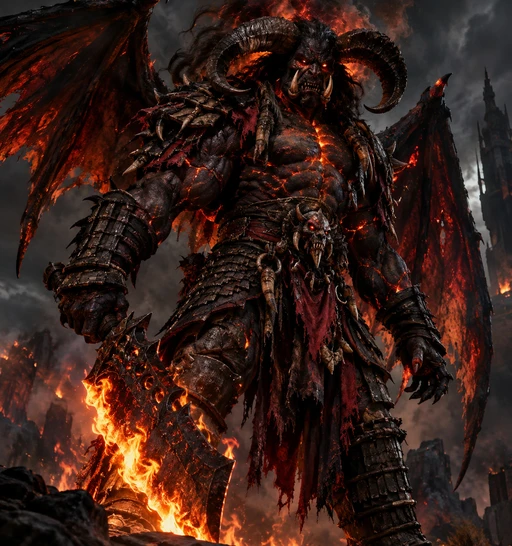
The blackened iron of Vorgûl’s hide cracked wider as he climbed, each step splitting the basalt shelf beneath him, fire leaking from the fissures in his arms like the veins of a…
Characters in this tale
The blackened iron of Vorgûl’s hide cracked wider as he climbed, each step splitting the basalt shelf beneath him, fire leaking from the fissures in his arms like the veins of a mountain about to birth a caldera. Below, the shattered terraces of the Ember Spire fell away into smoke, and above, the last platform waited — a slab of obsidian wide enough for two titans and nothing more. He had climbed seven tiers of this ruin to reach it. He did not intend to descend.
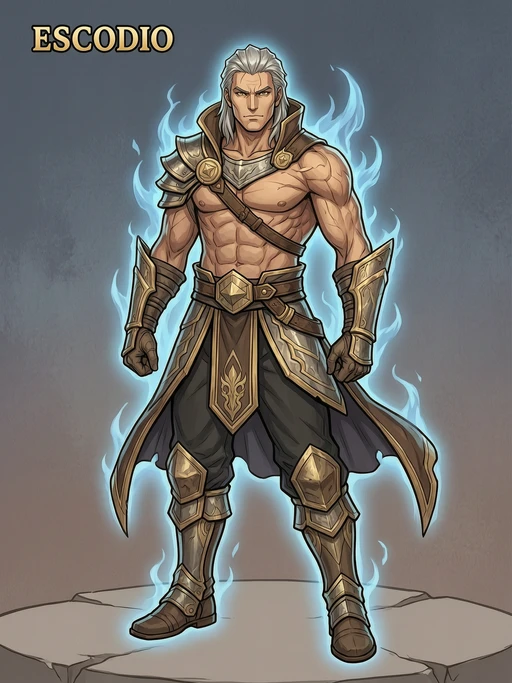
Escodio stood at the platform’s far edge, silver hair lifting in the updrafts, bronze and gold plates catching the red glow. The blue flame around him burned steadily, unhurried, the way a forge burns when the smith knows the metal will take its time.
“You climbed,” Escodio said. His voice was flat, worn smooth by centuries. “Most burn out on the third tier.”
Vorgûl hauled himself onto the platform, wings of shadow and ember scraping sparks across the stone. Smoke curled from his tusked jaws. “Most are not me.”
“No,” Escodio agreed. “Most are not.”
For a long moment neither moved. The wind carried ash between them. Vorgûl studied the blue fire — how it did not flicker, how it fed on nothing he could see — and understood that this was not a man who could be overwhelmed. The warlord’s instinct, honed across a hundred burned kingdoms, told him the truth of it: this foe grew stronger the longer he stood. Every heartbeat of delay was a gift to the enemy.
So Vorgûl gave him no heartbeat.
He hurled his vast cleaver in a low, screaming arc, flame sheeting off the blade, and the impact drove Escodio back across the obsidian — but only back, boots skidding, not falling. The blue aura flared where the fire touched it and swallowed the heat whole. Escodio planted his feet, caught the second swing on his armored forearm, and the bronze did not crack.
“Good,” Escodio said. Nothing more. He stepped in and hammered a fist into Vorgûl’s chest, and the blow rang through the iron hide like a bell struck in a deep mine.
Vorgûl felt it — felt the sheer accumulated weight behind it, the strength of a thing that had endured every hardship ever thrown at it and kept the interest. He staggered back a pace. The blue flame around Escodio brightened. It was already growing.
*He scales,* Vorgûl thought, and the old chieftain’s mind, colder than his body, began to work.
He could not win a war of attrition. He could not win by standing and trading. He needed height, leverage, and a single decisive stroke — and he needed to deny the enemy the long grind his power fed on. The platform’s far side dropped into a chasm of smoke; the near side rose to a broken spire of rock, jagged and unstable, higher than a man’s reach.
Vorgûl turned and ran for it.
Escodio followed without haste, which was its own kind of menace. “Running is wise,” he called. “Wise and useless.”
Vorgûl did not answer. He launched himself up the spire, claws tearing handholds from the stone, wings beating ember and shadow, and hauled his massive frame onto a ledge that overlooked the obsidian slab. Below him, Escodio arrived at the base of the spire and looked up — and for the first time, something like caution crossed the stoic face. He could not climb quickly in that heavy plate. He could only wait, or leap, or endure what came.
That was the whole of Vorgûl’s design.
He seized a slab of the broken spire, a boulder the size of a war-chariot, and heaved it down. Escodio raised both arms and took the impact full on his shoulders, driven to one knee, stone shattering around him. The blue flame guttered — guttered, then steadied, then grew brighter still, because the man was built to survive exactly this. He rose. He was stronger than he had been a breath ago.
Vorgûl had expected no less. The boulder had never been meant to kill.
It had been meant to pin him in place.
Before Escodio could clear the rubble from his legs, Vorgûl dropped from the ledge — not onto him, but past him, landing on the far side of the platform between the warrior and the only path down. He had taken the high ground, spent it, and now he took the low. Escodio, half-buried and slowed by his own armor, understood the trap a moment too late: there was no longer anywhere for him to retreat, and nowhere for the warlord to be pushed off.
“You gave me the climb,” Escodio said, wrenching free. “You gave me the fall.”
“I gave you nothing,” Vorgûl rumbled. “I took the mountain and left you the rock.”
And then he came in low and fast, cleaver burning, no more feints and no more patience. Every blow was aimed not at the armor but at the joints, the seams, the places where even an immortal body must bend. Escodio met him blow for blow, and his strength climbed with every exchange, the blue flame rising until the obsidian beneath them glowed white — but Vorgûl did not slow. He had stopped trying to outlast his enemy. He was spending everything now, all at once, the way a chieftain spends his last warriors to break a shield wall.
The decisive moment came as Escodio drew back for a blow that would have ended it — and Vorgûl, instead of dodging, stepped *inside* the swing. He caught the warrior’s arm in the crook of his own, wrenched the joint against the grain of the armor, and drove his horns into Escodio’s chest. The impact lifted the silver-haired warrior off his feet and carried them both toward the platform’s edge — the edge Vorgûl had chosen, the edge that dropped into the chasm of smoke.
Escodio’s hands closed on Vorgûl’s mail. If they fell together, they would fall together.
But Vorgûl had wings.
He beat them once — shadow and ember roaring — and arrested his own fall at the very lip, while the warrior’s grip tore loose and Escodio plunged backward into the smoke. The blue flame fell with him, a comet of cold fire swallowed by the dark, and somewhere far below there was a sound like a forge being quenched.
Vorgûl stood at the edge, breathing smoke, blood of fire dripping from the cracks in his hide. He did not look down for long.
“Endure that,” he said.
The chasm answered only with wind. The Flame-Tyrant turned from the ledge, wings folding, and took the platform as his own — for the mountain, like everything else in the East, belonged to whoever was still standing on it.
The recorded ending
This encounter ended with Vorgûl, the Flame-Tyrant still standing.
This fictional story was generated by PicWar AI from player-created characters and a public battle for entertainment. It does not describe real people or events.Would you rewrite this ending?
Create a hero who could challenge Vorgûl, the Flame-Tyrant.
Start with a sketch or image, create your own hero in PicWar, then send it into a new battle story.