An arena chronicle
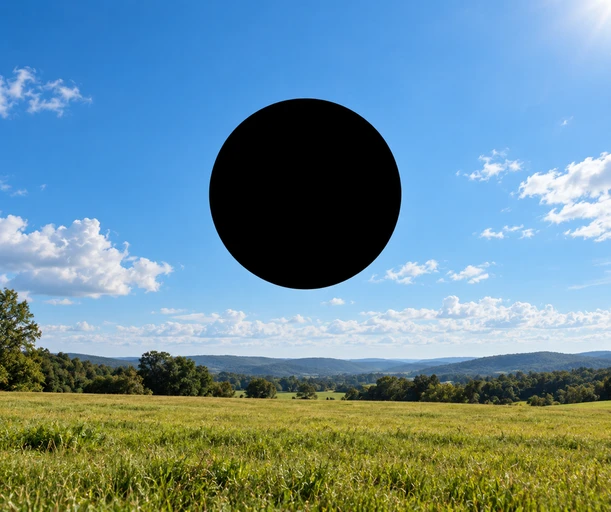
Skorpis Khan VS hole
Skorpis Khan climbed. He did not climb because he wished to; he climbed because the thing above him had already taken the ground he stood on. The green hillside below had been…
Characters in this tale
Skorpis Khan climbed.
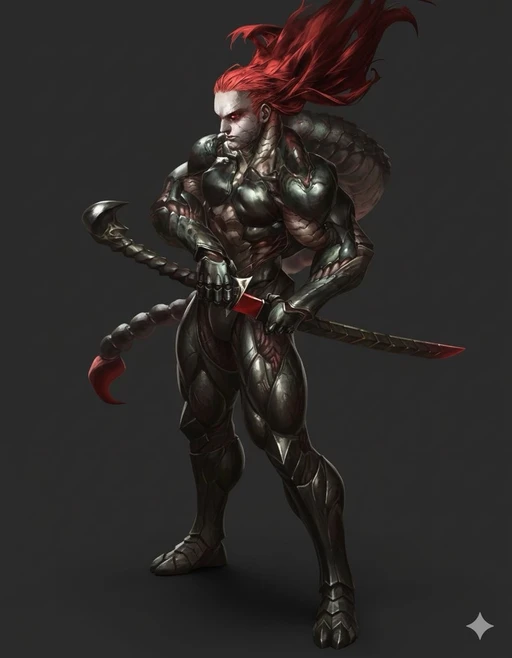
He did not climb because he wished to; he climbed because the thing above him had already taken the ground he stood on. The green hillside below had been vibrant minutes ago—grass, wildflowers, a river bending silver through the valley. Then hole drifted down from the sky, a perfect matte-black circle with no edge, no texture, no depth, and where its shadow fell the hillside simply stopped being. Not burned. Not torn. Removed, like a word scraped off a page.
So he climbed the terraced cliff, chitin plates scraping handholds out of the stone, red hair whipping in the updraft. Four arms' worth of grip and a scorpion's tail counterbalancing his weight, he hauled himself ledge to ledge while the void descended behind him at its unhurried, patient pace. Discipline said: find the high ground. Rage said: kill it. Discipline won, for now.
"You are a rude little absence," he muttered, vaulting onto a wide stone platform where an old shrine clung to the cliff. "I have been buried for centuries. I have earned the sky."
The sky did not answer. hole had no voice. It drifted level with the platform, and the shrine's far corner—pillar, roof, shadow—ceased to participate in reality. Skorpis Khan was already moving.
He learned the rules fast, because learning fast was the only thing keeping him. The void could not be struck. Kheltaris, his living crimson blade, sang as he whipped it through a testing arc at the black disc, and the blade passed through nothing at all, feeling no resistance, no impact, no feedback—as though he had swung through a hole in the world, which, he supposed, he had. The sword's glow dimmed where it crossed the boundary, and Skorpis yanked it back before the crimson edge could be eaten away. Not a foe. A condition. A rule of the terrain, drifting.
"Fine," he said, low and resonant, monk-calm under the barbarian's grin. "You are a cliff you can walk into. So I will not walk into the cliff."
He bounded backward, up another tier of stone stairs cut into the rock, and the void followed. That was its whole nature—it approached, and whatever entered its space stopped existing. No intent. No malice. Just the silent arithmetic of subtraction.
So he gave it arithmetic of his own.
From the shrine platform he kicked loose a stone block, and it tumbled into the black circle and did not emerge. He threw a second, a third—each gone without sound, without ripple. But he watched the disc's drift, and his crimson eyes narrowed. It did not chase. It proceeded. It held its course with an apathy so total it was almost admirable, and when he darted sideways along a narrow ledge, the void adjusted only lazily, sliding down the cliff face along the same unhurried vector.
It does not adapt, he realized. It simply is.
The thought lit him like a struck match. He had spent centuries entombed, motionless, and it was motionlessness that had nearly unmade him. This thing was the same disease, wearing the sky as a mask.
Skorpis Khan climbed again—higher, faster, claws punching through weathered stone, tail lashing for balance. He reached a narrow bridge of rock spanning a gorge, a natural arch with a mirror-still pool beneath it catching the whole green valley in reflection. And there, above the pool, he stopped.
The void rose to meet him, level with the arch, level with the sky.
And Skorpis Khan did something no barbarian would have thought to do and no monk would have dared: he stood perfectly still, planted Kheltaris point-down into the stone, and let the plateau's fracture line—already split by his climbing weight—crack the rest of the way.
The arch crumbled. Skorpis Khan dropped, not away, but down and to the side, catching a lower ledge with his tail's hook and swinging himself clear as the cliff's upper shelf collapsed into the gorge. The rocks fell. The pool's mirror surface shattered into rippling silver.
And the void, proceeding on its fixed, unalterable course, drifted into the space where the arch had been—and met its own reflection rising to greet it in the broken water.
For one long heartbeat the world held its breath.
hole had no mind to be confused. But it had rules, and one of them, buried in the memory of battles past, was this: it could not be mirrored. Two absences facing each other across the same line of reality were a contradiction even a contradiction could not survive. The black circle met its own black circle, and the two perfect edges touched—
—and canceled.
The void did not explode. It did not shriek or struggle. It simply stopped being a thing that was happening. The matte-black disc thinned to a hairline, a thread, a smear of absence, and then the sky over the green valley was only sky, blue and enormous and entirely willing to be looked at.
Skorpis Khan hauled himself onto the surviving ledge, chest heaving, chitin scratched white with rock dust, Kheltaris still humming its crimson note in the stone. Below, the valley's river ran on, oblivious. Above, nothing remained. No sound. No ripple. No trace.
He pulled the blade free and looked up at the empty blue for a long, disciplined moment, and then he laughed—low at first, then full-throated, a barbarian's laugh at the top of a broken cliff.
"Centuries in a tomb," he said to the sky, "and I learn the same lesson twice. Stillness kills. But a mirror—" He turned the crimson blade, watching the valley gleam in it. "A mirror teaches it to kill itself."
He climbed down toward the green, free, unerased, and entirely pleased with himself.
The recorded ending
This encounter ended with Skorpis Khan still standing.
This fictional story was generated by PicWar AI from player-created characters and a public battle for entertainment. It does not describe real people or events.Would you rewrite this ending?
Create a hero who could challenge Skorpis Khan.
Start with a sketch or image, create your own hero in PicWar, then send it into a new battle story.