An arena chronicle
Orrvak VS Porcelain Puppet Prince
The hall had been a nursery once. Orrvak knew it by the smell of it—old varnish, rotted lace, the dust of forgotten playthings—and he did not care. He came through the arches low…
Characters in this tale
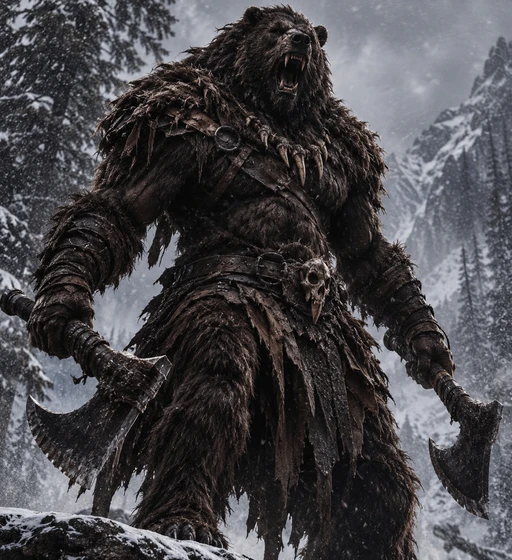
The hall had been a nursery once. Orrvak knew it by the smell of it—old varnish, rotted lace, the dust of forgotten playthings—and he did not care. He came through the arches low and slow, axes held wide, claws ticking against the flagstones with every step.
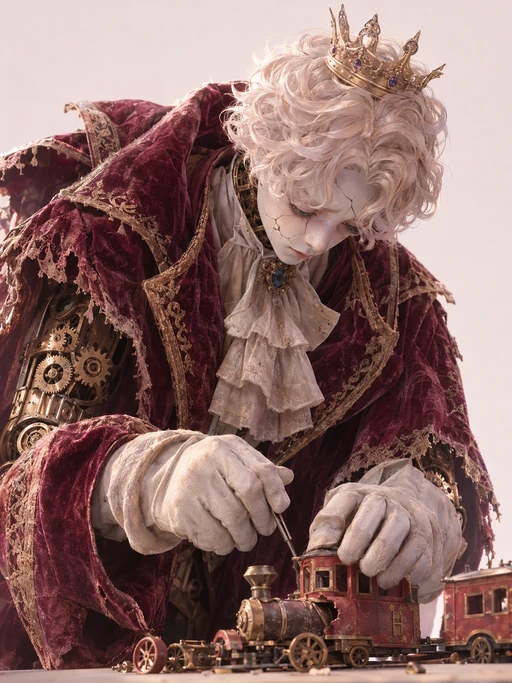
At the far end, beneath a cracked window of colored glass, the Porcelain Puppet Prince knelt beside a toy train and tried to mend it.
"Please," said the Prince, without rising, his voice warm brass under velvet courtesy. "You will tread upon the little track. I have only just laid it. I must ask your pardon in advance for any inconvenience."
Orrvak answered with a growl that was almost a word. "Move."
The Prince set down the train with painful gentleness, rose, and bowed—deep, formal, a courtier's bow in a ruined nursery. His great tattered coat swallowed the clockwork of his limbs. Then his thick-gloved hands swept the floor, and the nursery answered him.
Tin soldiers he had arranged along the skirting boards marched off their shelves in clattering ranks. A rocking horse lunged on split rockers. A music box wound itself and shrieked a waltz that needled the ears. The hall filled with motion, all of it small, none of it Orrvak.
He did not flinch at noise. He had hunted in worse. He swatted the rocking horse into splinters with the flat of an axe and crushed a column of soldiers under one broad paw, and the waltz went on piping, and the Prince stepped back behind a fallen cradle, and back again, and again—always retreating, always precise, always keeping furniture between them.
So that was the game. Orrvak had seen it before, on ice and in bog: the small clever thing that will not be caught, that gives ground to buy time, that hopes the heavy thing exhausts itself.
He stopped.
The Prince halted too, porcelain face tilted, listening for the charge that did not come.
Orrvak lowered his axes and turned his head slowly, sniffing. Grease. He smelled grease and hot metal, and beneath it the fine high stink of a wound in something that could not heal itself. He followed it with his eyes, unhurried, and found the truth of the room: the Prince's left arm moved a half-beat slower than the right, and at the elbow the cracked porcelain gaped, and through the gap a gear had slipped its pin and was grinding, grinding, each turn smaller than the last.
*He is not retreating to tire me,* Orrvak thought, calm as winter. *He is retreating because he is breaking.*
He crossed the nursery in five strides.
The Prince flung up a distraction—a great hanging mobile of tin stars, spun loose to scythe between them—and Orrvak went under it in a crouch, took the swing on the flat of his axe, and drove on. The Prince's gloved hand seized the edge of a marble hearth and wrenched it free to hurl, elegant even in desperation, and Orrvak did not dodge. He came through it, stone bursting on his shoulder, fur and hide and muscle taking what would have felled a lesser thing, and he was already inside the throw.
The Prince's eyes—two polished lenses—widened. "Ah," he said softly. "I see. I have been read."
He turned to run for the archway into the adjoining gallery, coat streaming, clockwork legs ticking with a jeweler's precision. Orrvak let him reach the threshold.
Then he threw.
The axe took the Prince between the shoulders, not to kill—Orrvak was a hunter, and hunters know where the spine of a thing lies—but to stagger. Porcelain shattered along the crown of his back in a spray of white shards, and the Prince pitched forward into the gallery, and the gallery was narrow, and Orrvak filled it.
"Enough," Orrvak growled.
The Prince rose, swaying, one arm hanging useless, and bowed a last shallow bow. "I regret," he said, "that I cannot mend this."
He lunged—quick, clean, a thrust of a hidden blade from his sleeve—and Orrvak caught the wrist in one clawed hand, and closed, and the porcelain cracked like river ice in thaw. The blade fell. The Prince's other hand scrabbled for the wall, for anything, and found only Orrvak, who took him by the ruined shoulder and the collar of the velvet coat and lifted him from his feet.
For a moment the two of them stood so, the beast and the broken prince, in the narrow gallery with the colored light falling through the far window.
"You fixed the train," Orrvak said.
"I did try," whispered the Prince. "It was a very good train."
Orrvak set him down—gently, all things considered—against the wall, and held him there with one paw while the other reached and turned the slipped gear back onto its pin. The grinding stopped. The little arm stilled.
The Prince looked at him, lenses brightening with something like wonder. "Why?"
"Because you were already beaten," said Orrvak, "and I am not wasteful."
He let go, and the Porcelain Puppet Prince slid down the wall to sit among the shards of his own crown, breathing in small metallic sighs, while the music box in the nursery ran down at last and the hall went quiet.
Orrvak took up his axes, and went on through the gallery, and did not look back.
The recorded ending
This encounter ended with Orrvak still standing.
This fictional story was generated by PicWar AI from player-created characters and a public battle for entertainment. It does not describe real people or events.Would you rewrite this ending?
Create a hero who could challenge Orrvak.
Start with a sketch or image, create your own hero in PicWar, then send it into a new battle story.