An arena chronicle
Nurgle VS Kratos
The air in the Void Arena tasted of ozone and sulfur, a metallic tang that lingered within the lungs of every spectator and participant alike. The space was a desolate expanse of…
Characters in this tale
The air in the Void Arena tasted of ozone and sulfur, a metallic tang that lingered within the lungs of every spectator and participant alike. The space was a desolate expanse of shattered marble columns, remnants of a forgotten civilization, suspended in a void of swirling green mist and grey ash. This was the crucible where Summoners pitted their champions against one another, testing not just strength, but the very philosophy of power embodied by their servants. On one side stood the embodiment of decay, Nurgle, the Plaguefather. On the other stood the Ghost of Sparta, Kratos.
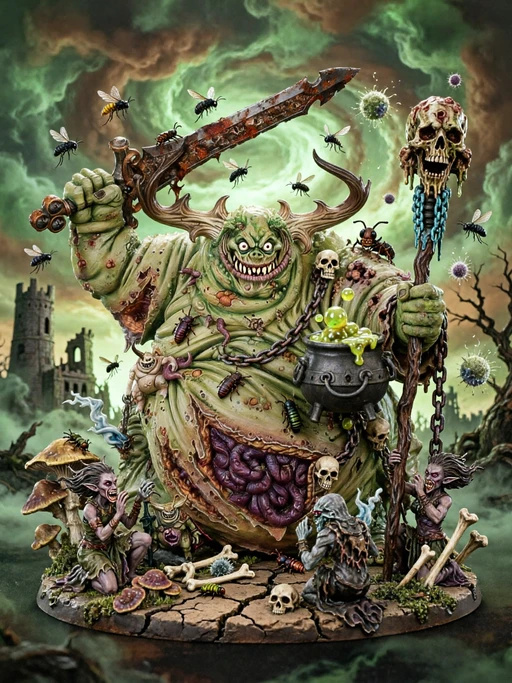
Nurgle was a colossal figure, a walking landscape of disease. His skin was a patchwork map of festering wounds, oozing thick, iridescent fluids that sizzled upon contact with the dry stone beneath his feet. Large, writhing maggot colonies swam within the open sores of his flanks, pulsing with a sickening rhythm. An oversized, twisted crown of horned bone rested atop his head, framing a face that was less skull and more swollen flesh stretched over jagged protrusions. In his massive left hand, he gripped a rusted greatsword, dull and pitted, while his right held a staff topped with a boiling cauldron. The liquid within glowed a toxic violet, emitting steam that coalesced into miniature storms of flies. He did not stand still; even in repose, he breathed, and with each inhale, the ambient air turned sluggish, filled with the buzz of unseen insect wings.
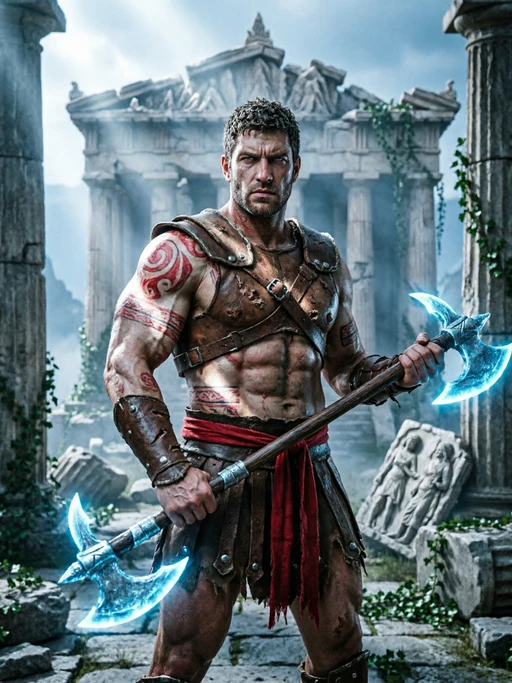
Opposite him was Kratos. He was starkly different, a monument of hardened muscle and stoic silence. His skin bore the pale, scarred texture of a man who had walked through hell itself, marked now by the crimson spiral tattoo on his right arm—a symbol of blood covenants that bound him to duty. He wore worn leather harnesses that offered little protection compared to his innate resilience, with a simple red loincloth hanging low. Two axes hung at his hips, though he held only the Leviathan variant, glowing with faint blue ice energy that contrasted sharply with the surrounding heat. His eyes were deep wells of cold fire, unblinking, scanning the battlefield not with fear, but with the analytical gaze of a predator calculating the trajectory of death. There was no chatter from the Spartan; his breathing was rhythmic, controlled, and devoid of panic.
As the signal resonated through the ether, neither side rushed blindly. This was not a brawl; it was a chess match played with steel and sorcery.
Nurgle began with a vocalization, a deep, gurgling sound that seemed to emanate from the earth itself rather than his throat. “Death... comes... sweetly,” the sound rippled outwards like water disturbed by a stone. He raised the boiling cauldron on his staff. The intent was clear: area denial and attrition. He would not chase; he would suffocate the opponent with time and poison. From his belly, the rot opened wider, releasing a cloud of spores that drifted lazily toward the center of the ring. These spores were not merely dust; they were microscopic constructs of life designed to consume biological structures.
Kratos stood rooted. He watched the flow of the air. He could sense the disruption in the mana currents caused by the Plaguefather’s presence. The air vibrated differently here; spells thrown into this atmosphere would splinter, lose cohesion. Yet, he knew that simply standing firm against Nurgle’s influence was futile. He needed to break the cycle of infection before it took hold in his pores.
A sudden realization struck the Spartan, a flash of insight drawn from his dormant memories. Though his growth status showed zero new progress, there was a ghost of a lesson burned into his consciousness regarding magical constructs. He remembered a battle years ago where a similar necromantic barrier was broken not by cutting the mage, but by severing the conduit of energy. It was a quiet echo in his mind, a reminder that while his memory remained idle, his instincts had sharpened through trial.
With a roar that sounded like grinding boulders, Kratos activated his innate capability. He deliberately drew a deep cut across his forearm, exposing the raw flesh beneath his tattoos. Crimson blood poured forth, not just pooling, but reacting. He invoked the *Godsbane Hemorrhage*.
The effect was instantaneous. The bright red blood did not stain the ground; it vaporized into a toxic, silver-blue mist that radiated outward in concentric waves from Kratos’s body. This was the alchemical residue, a substance forged in the fires of Olympus specifically designed to corrupt divine magic. As the mist met Nurgle’s encroaching spore cloud, a violent reaction occurred. The purple spores dissolved upon contact with the blue aura, turning into harmless black sludge that hissed away.
Nurgle paused. The cheerful grimace on his face twitched, revealing irritation beneath the optimism. “Oh... a pretty display... such... vibrant waste,” he gurgled, the voice distorting like a radio playing underwater. He swung his staff, attempting to push the toxin back with a wave of green gas. But the *Hemorrhage* resisted. It wasn’t fighting fire with fire; it was dismantling the chemical bonds of the magic itself.
The psychological pressure mounted. Kratos was silent, but his movement was aggressive. He lunged forward, closing the ten-meter gap between them with terrifying speed. It was a feint.
Nurgle anticipated the charge. He did not dodge; instead, he widened his stance, preparing to catch the Spartan in a crushing grab. As Kratos neared, the Champion’s foot skidded in the mud, sending a spray of corrupted soil into the air. But Kratos didn’t stop. At the last millisecond, he dropped his shoulder, sliding under the swing of the rusted greatsword intended to cleave him in half. The sword missed by inches, striking a column behind him and shattering it into rubble.
While crashing into the debris, Kratos rolled to his feet, the blue glow of his axe intensifying. He had realized something vital during the lunge. The flies. They were the primary sensors for Nurgle, circling in patterns that mirrored the spread of his infection. To fight Nurgle was to fight a hive mind. Kratos threw the handle of his axe—not the full throw, but a sharp projectile toss aimed at the ground in front of Nurgle. It embedded itself deeply, but its true purpose was the shockwave emitted upon impact.
The vibration disrupted the delicate flight patterns of the flies. For a brief second, the fog around Nurgle grew thin. His vision obscured. This was the opening Kratos calculated. While the enemy’s sensory input was scrambled by the mechanical disruption, Kratos stepped in.
He raised the axe overhead. This was the moment of decision. He could strike the gut, aiming to rupture the flesh and release the infectious core. Or he could strike the staff.
In his mind, Kratos recalled the nature of summoned beings. Their connection to the summoner plane was maintained by focus objects, conduits. For Nurgle, the cauldron was not just a tank; it was a stabilizer. Without the fluid in the pot, the bio-mass would lack cohesion.
But Nurgle, in his twisted wisdom, saw the danger of the blow. He did not try to block the axe; he tried to absorb the damage. He allowed the tip of the axe to scrape against his armored hide, knowing that flesh could heal faster than metal could pierce. He grinned, the sound wet and tearing. “Break... me... and... I become many...”
This was the trap. As soon as the axe made contact, the surface of Nurgle’s skin exploded outward. Instead of healing, the wound expanded into a swarm of smaller entities—smaller, faster versions of himself. The logic of the combat shifted. Physical damage was no longer effective; it was multiplication fuel.
Kratos felt the burn of the acid on his gauntlet. He gritted his teeth, ignoring the pain. He had anticipated this possibility, but the rate of regeneration was faster than predicted. This was the variable that tested his experience. In the silence of his own thoughts, a fragment of his history surfaced—the memory of facing a Hydra, of cutting heads off only to grow more. The solution then was fire. Here, it was isolation.
Kratos ceased his offensive strikes. He pulled back. He lowered the axe and placed a hand on the ground, channeling his remaining energy. He wasn’t attacking anymore; he was anchoring. He was creating a zone of absolute stasis around the immediate area, a vacuum of magic.
The *Godsbane Hemorrhage* was no longer just a defensive wall; Kratos inverted its polarity. By drawing the blood from his veins, he created a gravitational pull on the magic flowing around him. He forced the chaotic energies of Nurgle’s spawns to converge on him, hoping to create a singularity.
Nurgle sensed the shift. The buzzing of the flies stopped. The swelling in the air vanished. “What... what do you do?” the voice lacked its usual joy now. It carried a note of genuine confusion.
“You cannot divide what cannot connect,” Kratos rumbled, his voice low and gravelly, sounding as though spoken through stone.
He slammed the flat of his axe into the ground. The energy burst outward, forming a perfect circle of blue fire. Inside the circle, gravity intensified. All the swarms, all the spores, all the small creatures spawning from the wounds were crushed instantly into a single mass of pressurized matter. The magic holding them together fractured.
Nurgle roared, but it was a strained sound. His form shuddered. The connection to the chaotic essence was severed by the sheer concentration of opposing force. He tried to regenerate, but the toxins of Kratos’s blood were eating the very DNA of the decay.
Kratos moved in for the final strike. He did not swing wildly this time. He moved with the precision of a surgeon. He targeted the neck, aiming not to kill the head, but to sever the connection to the torso where the life-force regenerated.
As Kratos’s axe descended, Nurgle attempted one final desperate maneuver. He unleashed the contents of the boiling pot, a torrent of green lava meant to melt everything. But Kratos was already moving laterally, utilizing the momentum of his own thrust to slide sideways, using the falling rocks from the previous column collapse as cover. The lava consumed the stones behind him, but the Spartan was nowhere to be found in the line of fire.
Kratos emerged from the smoke, appearing suddenly behind the rotting giant. He drove the axe upward into the chest cavity, piercing the ribcage and impaling the central organ—the source of the corruption. The impact shook the arena floor.
Nurgle stumbled backward. The flies scattered, dying mid-air. The purple light in his eyes flickered and faded. The green mist dissipated rapidly, sucked up by the *Godsbane Hemorrhage*.
“Life... finds... a way,” Nurgle whispered, the words barely audible, lacking the power to sustain him.
“No,” Kratos responded, pulling the axe free. Blood spilled from the wound, but this time, it did not spawn new life. It leaked away, leaving the giant hollow and lifeless. The corpse collapsed, crumbling into a pile of harmless organic sludge and stone-dust within moments of death.
The victory was not born of mere strength. It was won through the understanding of the enemy’s mechanics and the willingness to endure self-inflicted injury to unlock a strategic countermeasure. Kratos understood that Nurgle thrived on complexity, on the messy spread of infection. He imposed simplicity and order on chaos. He accepted the risk of the bleed to buy the chance to strike the fatal blow. The fly pattern disruption was a calculated move to blind the enemy’s perception system, allowing him to bypass the defensive regeneration.
The Summoners’ platform fell silent as the dust settled. Kratos stood amidst the wreckage, wiping the acid from his axe. He did not boast. He did not cheer. He simply sheathed the weapon, his expression returning to its familiar mask of stoic resolve. The battle demonstrated that even against a deity of entropy, the mind armed with knowledge and sacrifice could carve a path to victory.
Nurgle had been powerful, but his reliance on overwhelming numbers and environmental control had been exploited by an opponent who refused to play by those rules. Kratos manipulated the battlefield conditions, using the terrain and his own physiology as weapons to dismantle the biological hierarchy Nurgle relied upon. The psychological edge lay in Kratos’s patience; he waited for the enemy to reveal their weakness, the dependency on the flying swarm, and the fragility of the containment vessel, the cauldron.
In the grand tapestry of the Summoner’s War, this duel served as a testament to the idea that power is not infinite. Even the Plaguefather can be contained, given the right counter-stroke and the will to execute it. The Spartan proved that while the universe may strive for decay, the spirit can choose to resist, and in doing so, rewrite the outcome of destiny.
The arena lights dimmed as the result registered in the system logs. The air cleared. Only the scent of ozone remained, fading slowly into the ether. Kratos turned, his boots crunching on the shattered glass of the dead champion, ready for the next call.
```json { "winner_name": "Kratos", "winner_index": 2, "summary": "Kratos utilized the anti-magical properties of his Godsbane Hemorrhage skill to neutralize Nurgle's plague attacks, executing a tactical feint to disrupt the enemy's swarm-based sensing system before delivering a precise decapitating strike to the biological core." } ```
The recorded ending
This encounter ended with Kratos still standing.
This fictional story was generated by PicWar AI from player-created characters and a public battle for entertainment. It does not describe real people or events.