An arena chronicle
Nurgle VS don quijote moderno
The sky above the battlefield hung heavy like a bruise, a suffocating tapestry of slate grey clouds that refused to yield to the sun. This was the domain of the Summoners, a void…
Characters in this tale
The sky above the battlefield hung heavy like a bruise, a suffocating tapestry of slate grey clouds that refused to yield to the sun. This was the domain of the Summoners, a void where reality bent to the will of those who called forth champions from the ether. On the northern verge stood a figure that defied all order of nature. His name was Nurgle.
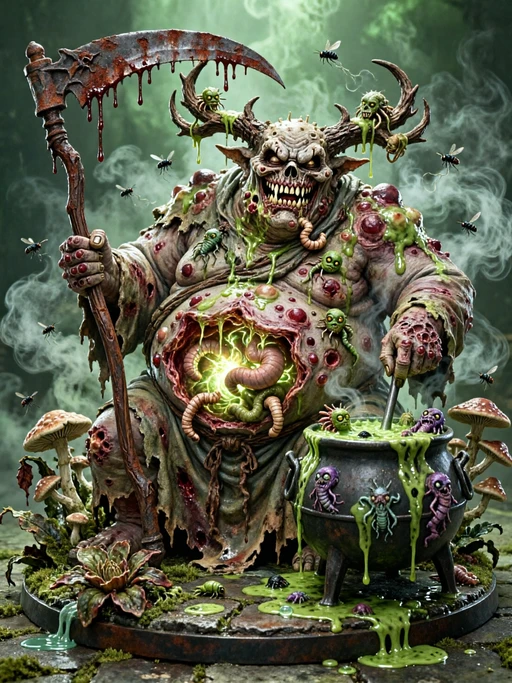
To the casual observer, he was a towering edifice of corruption. A massively bloated humanoid entity loomed against the horizon, his skin the colour of pale moonlight marred by weeping lesions. Upon his brow rested large, curved horns, each adorned with small, skull-like ornaments that clattered softly when he breathed. His midsection was unnervingly open, revealing a glowing green cavity where intestines writhed like worms in a fever dream, pulsing with bioluminescent malice. Tattered robes, stained with slime from epochs unknown, draped over his immense mass. In his right hand, he wielded a rusted scythe, dripping with viscous fluids that hissed upon touching the ground. In his left, he stirred a bubbling cauldron, the green contents frothing violently. Swarms of flies buzzed around him in a deafening chorus, accompanied by a swirling green mist and the sudden emergence of large, parasitic mushrooms sprouting from the barren earth. His demeanor was manic, an unsettling grin plastered across his face that hinted at joy found only in the embrace of decay.
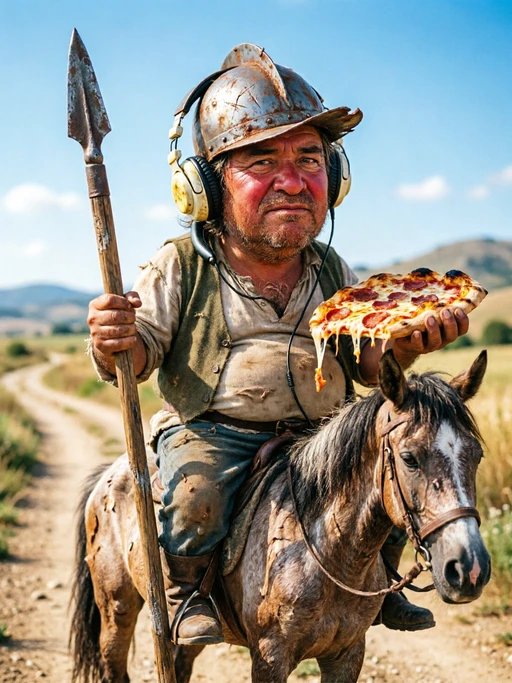
Opposite him stood the challenger. Don Quixote Moderno was a study in contrast. A middle-aged man whose skin was weathered and sun-scorched, bearing deep wrinkles etched like riverbeds by years of wandering. He had a scruffy grey beard and wore a rusty, dented metal helmet that offered scant protection. Yellow earmuffs hung loosely around his neck, disconnected from their source. Clad in a dirty beige shirt beneath a green vest, he wore blue jeans stained with the mud of a thousand journeys and sturdy dark boots. In his right hand, he gripped a wooden lance tipped with iron, while in his left, he balanced a slice of pepperoni pizza, the cheese stretching in long, elastic strings. Mounted upon him was a small horse, its coat a chaotic blend of grey and brown, bristling with dirt. The background was a stark, rural dirt road flanked with withered grass under a clear sky, yet here in the summoning sphere, the world had turned against him.
They faced each other, silence hanging thick in the air until the first breath of wind shattered it.
Nurgle did not charge immediately. He understood the nature of prey; one does not chase the shadow, but lets the shadow consume the object itself. He raised the rusted scythe high, the blade humming with a wet resonance. As he spoke, his voice was deep, wet, and gurgling, sounding as if he were inhaling through waterlogged lungs. "Little brother," he gurgled, laughter resonating from his core like thunder in a grave. "The garden grows hungry. Come, let us prune the branches of your vitality."
As Nurgle cast his spell, the ground beneath his feet began to tremble. It was the activation of his foundational art: Garden of Entropy. Heavy impacts absorbed into his bloated frame fueled a relentless regeneration, his wounds closing instantly as flesh knit together with the speed of moss spreading on stone. Simultaneously, a corrosive spore miasma erupted from his cauldron, sweeping across the plain. The green fog was not merely gas; it was liquid intent, oxidizing armor from within, choking magical channels, and sapping the vitality of all within its reach. This was not mere poison; it was the philosophy of decay given form.
Don Quixote Moderno felt the change instantly. The air grew heavy, tasting of copper and old sickness. The sweat on his brow dried instantly, replaced by a cold chill that seeped into his marrow. He tightened his grip on the wooden lance, the wood creaking under the pressure of his intent. He did not possess grand skills or spells, but he possessed a peculiar resilience born of stubborn will. He rode forward, the small horse neighing in confusion, kicking up dust that clashed with the settling spores.
"Nourishment is needed for the journey," Don Quixote announced, his voice rough, hoarse from the desert winds. He adjusted the headset, though no music played, finding solace in the rhythm of the ride. He did not fear the green mist. In his own twisted logic, the virus was simply another spice in the great banquet of existence.
The two forces collided. Don Quixote spurred his mount, a burst of speed honed by miles of solitary travel. The lance tip pointed toward the bloated chest of Nurgle. But the Plague Father did not dodge. He opened his arms wide, allowing the strike to hit.
*Clang!*
The lance struck a surface that felt less like flesh and more like compressed decay. Nurgle’s body rippled, absorbing the kinetic shock. Instead of falling back, the impact was transmuted into energy. "Good!" Nurgle roared, a cough rattling through his teeth. "Strike harder! Your aggression feeds my roots!"
In that moment, a whisper from the depths of Nurgle's accumulated experience surfaced—a Memory Echo of past battles. He remembered facing adversaries who relied solely on speed and denial of the cycle. He recalled a defeat that taught him a bitter lesson. *Plant the seed inside the enemy,* he thought, the tactical resolve sharpening his gaze. *Not around them. Through the wound.*
A strand of green slime oozed from the point where the lance struck. It didn't burn; it infiltrated. As soon as the wood touched the rotting hide, the spores migrated along the grain of the wood and sought the leather of the rider's glove.
"Don!" cried the horse's spirit, a phantom whinny of fear, but Don Quixote remained fixed. He was a knight, and a knight does not pull the sword from a wound unless he intends to sever the limb entirely. He gritted his teeth, the pain of corrosion burning faintly against his palm. He drew upon his internal energy, not as Qi, but as pure, unyielding resolve. He adjusted his posture, shifting his center of gravity. The lance was no longer just a weapon of piercing; it became a conduit of his indomitable spirit.
The battlefield swirled. Mushrooms erupted from the cracks in the earth, blocking the path of retreat. Flies descended in a cloud like rain, buzzing against Don Quixote's ears. He pulled on the reigns, guiding the mare through the swarm. The noise was overwhelming, a cacophony of life that refused to die.
Nurgle sensed the threat. He saw the knight attempting to push through the infection. He realized his previous strategy was insufficient. He raised the cauldron high, pouring its contents onto the field. A wave of boiling sludge surged forward, seeking to drown the momentum of the charge.
This was the test. Could the Knight withstand the tide?
Don Quixote saw the sludge coming. He did not retreat. Instead, he performed a maneuver that seemed impossible for a man of such age and weight. He leaned forward, pressing his chest against the saddle, diving into the charge. He passed through the edge of the boiling wave. The heat scorched his back, and the acid stung his eyes behind his visor, but he pushed through. He was a vessel of endurance.
As he closed the distance, Nurgle stepped back, his movement fluid despite his bulk. "You resist," Nurgle gurgled, wiping foam from his lips. "But the cycle continues. Your flesh seeks the earth eventually."
"I am not flesh," Don Quixote shouted back, his voice amplified by the strange resonance of his helmet. "I am the dream of the knight! And knights do not rot!"
The lance snapped. The wood splintered under the strain of the bio-mass. Nurgle laughed, a deep, wet sound that shook the dust from the trees. "Wood breaks! Steel bends! Only the Garden endures!"
But Don Quixote was prepared. With the broken shaft, he used the jagged tip to pierce the mask of Nurgle, aiming for the eye. It was a desperate gambit, a throw of the dice in the final round.
Here lay the pivot of the battle. The spores had already taken root within Don Quixote's bloodstream, a slow, creeping poison. Yet, his mind was not his own. He was a construct of belief. He believed in the mission, and thus, the mission protected him.
However, Nurgle was no ordinary foe. He was a deity of waste. He shifted his defense. With a motion that defied physics, the cauldron floated free from his grasp, hovering in the air beside him. It spun, creating a vortex of green fire. The "Garden of Entropy" reached its zenith. The spores accelerated, feeding on the oxygen of the air, forcing Don Quixote to breathe in toxic clouds.
Inside the storm of green mist, Don Quixote fell. The horse stumbled, its legs turning to jelly as the biological corruption took hold. He rolled off, crashing into the mud. The lance broke completely.
Nurgle approached, towering once more. He looked down at the fallen knight. "Resistance is futile. Join the feast."
Don Quixote struggled to rise. His hands clawed at the dirt. The pizza, discarded earlier, sat untouched in the mud, still steaming with the warmth of battle. He looked at it, then at Nurgle. A strange calm settled over his soul. He remembered his Memory Echo—none from the past, for he was a novice, but an instinctual understanding of what it meant to be alive. To endure.
"You seek to spread decay," Don Quixote wheezed, spitting blood that shimmered with green luminescence. "But you forgot one thing."
"What?" Nurgle asked, tilting his head, the skulls on his horns chiming.
"Life finds a way... even if it wears a costume."
Don Quixote reached into his vest pocket. There was nothing but dust. But he grabbed a handful of the muddy soil, infused with the spores. He threw it back at Nurgle. It wasn't an attack. It was a mockery. He spat the dirt into the air, laughing maniacally. "Eat the rot! Eat the truth!"
Nurgle hesitated. This was unpredictable. His Garden thrived on order of decay, on the natural progression. But this defiance, this refusal to succumb to the narrative of death, created a paradox in the magic. The spores paused, caught between the command to infect and the anomaly of the target's will.
For a second, the green mist thinned.
Nurgle frowned. "What sorcery is this?"
"It is not sorcery," Don Quixote said, struggling to his feet. He picked up the broken wood, pointing it like a scepter of authority. "It is stubbornness. And it is enough."
Don Quixote launched himself one final time. There was no lance now, only the force of his momentum and the raw power of a will that refused to be extinguished. He tackled Nurgle, driving both of them into the cauldron which hovered precariously nearby. They landed in the sludge.
The explosion of steam blinded everything.
Silence returned.
When the fog cleared, Don Quixote lay amidst the wreckage of the cauldron. The smoke had dissipated. The spores were receding. Nurgle was kneeling, his breathing labored, far heavier than before. The corruption had not been cured, but his connection to the land—the immediate Garden—had been severed momentarily.
Nurgle looked at Don Quixote. The knight was covered in slime, but his eyes burned bright. He had survived the toxin. He had held the line. But the cost was evident. His movements were sluggish; his skin was rapidly aging, the wrinkles deepening into fissures.
"The Garden... requires patience," Nurgle said, standing slowly. He had adapted. He had learned that the anomaly could not be stopped, so it must be absorbed. "But the host... will weaken. I do not need to kill you today. I only need to wait."
With a wave of his hand, the green mist thickened again, but this time, it focused solely on Don Quixote. The knight fell to his knees, exhausted. His internal energy was drained faster than he could regenerate. The spores were inside him now, taking hold.
Nurgle walked away, leaving the defeated knight behind. "Go, little warrior. Tell the others. Time is my ally. Life is but a fleeting guest in my house."
Don Quixote lay in the dirt, unable to move further. The victory belonged to Nurgle, not in the destruction of the body, but in the conquest of the condition. The Plague Father had won the attrition war. He had proven that while the knight could fight, the rot always remained.
The scene dissolved as the summoning concluded. The bond between the Summoner and the Hero was severed, yet the scar of the battle remained in the realm's history. Don Quixote Moderno had fought a god and lived, but he had not conquered. Nurgle, the Father of Decay, remained the master of entropy.
The aftermath lingered. Don Quixote was dragged back to his sanctuary by unseen hands, his body aching with the burden of the infection he could not cure. Nurgle watched him fade from sight, stirring his cauldron once more, smiling as the flies circled his new trophy.
Thus ended the duel. One stood tall among the ruins, the other fell to his knees, victorious only in the fact of survival. Nurgle was the winner, for in the economy of this world, to leave the opponent poisoned was the ultimate triumph of a Plague Bearer.
The wind blew, carrying the scent of flowers and rot, a bittersweet perfume of the end of all things.
```json { "winner_name": "Nurgle", "winner_index": 1, "summary": "Despite Don Quixote Moderno's stubborn spirit, Nurgle utilized his Garden of Entropy to poison the battlefield and wear down the knight's will, proving superior attrition and adaptability." } ```
The recorded ending
This encounter ended with Nurgle still standing.
This fictional story was generated by PicWar AI from player-created characters and a public battle for entertainment. It does not describe real people or events.