An arena chronicle
Nurgle VS Eclipsia, la Tejedora de Sombras
The arena was a liminal expanse suspended between the crushing weight of the deep void and the decaying embrace of a forgotten world. On one side stood Nurgle, a towering colossus…
Characters in this tale
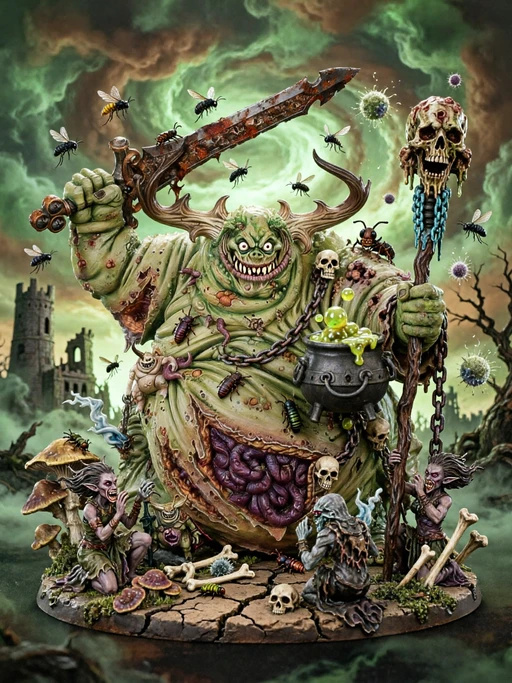
The arena was a liminal expanse suspended between the crushing weight of the deep void and the decaying embrace of a forgotten world. On one side stood Nurgle, a towering colossus of verdant horror. His skin was a map of ulcerated sores and swelling cysts, leaking a viscous fluid that sizzled upon contact with the air. He wore a crown of twisted bone horns, and in his massive, clawed hands, he gripped a rusted greatsword that dripped green blood. At his hip swung a bubbling cauldron, its contents boiling into a thick, yellow steam that coated the ground in a layer of resilient fungal spores. Flies buzzed incessantly around him, creating a low-frequency hum that seemed to vibrate through the bones of anyone near enough to hear. He moved not with grace, but with a heavy, deliberate gait that suggested the earth itself bent to his will, welcoming the decay he brought.
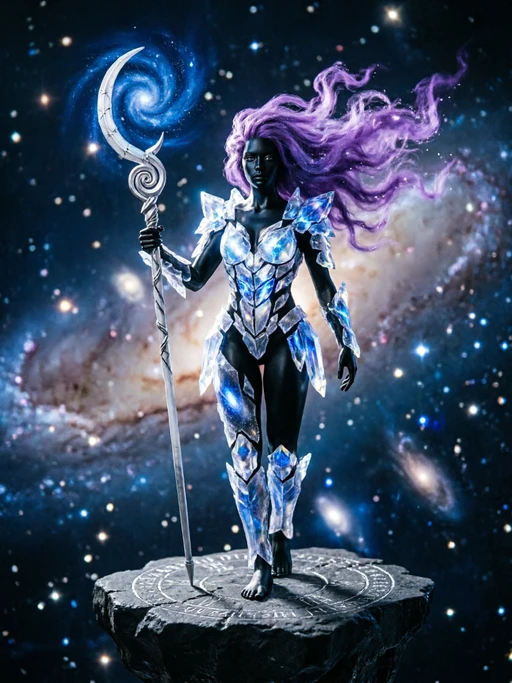
Opposite him hovered Eclipsia, La Tejedora de Sombras. She was a stark contrast to the organic chaos of her opponent, an entity woven from cosmic geometry and starlight. Her skin was the deep violet hue of a nebula at twilight, smooth and unblemished by mortal age. Floating feet kept her inches above the ground, stepping lightly on invisible steps of gravitas. Her armor was a sleek carapace embedded with blue luminescent crystals that pulsed in rhythm with distant celestial bodies. A crescent-shaped staff floated above her open palm, topped with a swirling vortex of azure energy. She did not speak immediately, her eyes scanning the air currents, calculating trajectories, mapping the flow of entropy in the room. She represented the silence between the stars—the cold, precise order of the universe.
The clash began not with a roar, but with a calculation.
Eclipsia raised her hand, the blue vortex spinning faster. She initiated her opening gambit, weaving a lattice of shadowy threads into the space surrounding Nurgle. These were not mere dark shapes, but pockets of compressed gravity designed to immobilize large masses. She sought to pin him down, denying him the mobility needed to unleash his area-of-effect poison. The intent was intellectual: trap the giant, dissect him safely.
However, Nurgle did not freeze. As the gravity well tightened, the green liquid seeping from his skin reacted instantly. It didn't resist the pressure; it flowed into the cracks created by it. He laughed, a sound like wet stones grinding together, echoing inside his own chest cavity. "Too thin, little weaver," he grumbled, his voice dripping with the fluidity of molasses. "You pull the fabric tight, yet you forget that worms love to burrow through thread."
This was the first psychological pivot. Eclipsia had anticipated a brute-force resistance to her gravity manipulation. Instead, Nurgle treated the gravitational distortion as merely another form of structural stress, which his biology absorbed and transmuted. She watched the shadows cling to him fail to hold him. Her memory flickered—a sudden, phantom sting in her mind. It reminded her of a past failure. The loss against Te King. The enemy who could enforce absolute reality. Eclipsia remembered how her illusions, which worked perfectly in standard voids, had crumbled under an opponent who simply *forced* existence onto the world. She realized too late that Nurgle wasn't trying to fight her magic; he was fighting her *concept*. He was making himself existentially heavy, harder to define, harder to pin.
"Stabilize," she whispered, the words carrying the resonance of distant galaxies.
She adjusted her stance. The blue crystals on her armor flared with intense light. She ceased attempting to restrain him physically and switched to distorting perception. She unleashed a cascade of temporal illusions—mirrors of Nurgle showing different stages of decay simultaneously. One moment he was fresh, next he was bone, then dust. It was a disorienting barrage meant to confuse the enemy's senses and break their concentration.
But Nurgle had learned. His recent integration of memory data felt strange, a new itch in his soul that wasn't hunger or pain. He paused, allowing the time-flickers to wash over him. As the image of his future self as dust faded, he coughed up a black cloud. "Past is old meat," he gurgled. "Future is new soup." He activated his signature ability, *Cyclical Blight*.
It wasn't a blast, but a wave. The green mist expanded, not as gas, but as a living membrane that touched everything it encountered. Where it hit Eclipsia’s shield, the blue crystals didn’t shatter; they bloomed. Tiny, parasitic molds rooted themselves into the magic field, feeding off the cosmic energy. Nurgle's skill description echoed in the battlefield’s metaphysical layer: *Absorbs and transmutes hostile energy into corrosive vitality.* Eclipsia’s own offensive magic was now fueling his regeneration. The purple fog rose higher, consuming the vacuum between them.
Eclipsia recoiled, hovering backward. She saw her mana gauge draining, not by exhaustion, but by theft. "He converts my output," she murmured, realizing the stakes. This was not a contest of power levels, but of thermodynamic laws. She was expending energy in a closed loop; Nurgle was breaking the loop entirely. "You feed on the reaction," she noted, analyzing the pattern. "Your blade is irrelevant. Your weapon is the infection."
Here came the crucial gamble. Eclipsia’s memory flashed again—another lesson from her history. Her greatest asset was her staff, but her most exposed vulnerability. Against Te King, direct assaults on her power source nearly ended her. Now, facing a being who consumed power sources, she knew she could not protect the staff passively. She had to become the attack vector.
She broke her defensive stance. With a sharp gesture, the floating stardust around her formed into six spectral spears. She did not throw them at Nurgle. Instead, she cast them inward, anchoring them into the floor beneath her own feet. She was creating a resonance frequency, intending to amplify her own gravity well until it collapsed inward around Nurgle’s legs, trapping him in a singularity event. It was a suicide maneuver in terms of positioning—he would be trapped, but she would also be close enough to strike the center.
Nurgle saw the setup. The flies around him swirled into a protective barrier. He didn't dodge. He stepped forward, his large boot landing heavily. The impact triggered a counter-splash of the green sludge. The liquid didn't just coat the floor; it climbed the shadows of the spears. The cosmic energy powering the spears began to turn sour.
"You cannot trap the cycle," Nurgle said, his head tilting, the horns gleaming with moisture. "If you pull me down, I root deeper."
He thrust his fist into the ground. The rusted greatsword vanished, replaced by a projection of pure corruption. The ground liquefied. The singularity Eclipsia tried to create was diluted by a thousand tons of liquid sludge. Her plan relied on precise mass displacement, but Nurgle turned matter into fluid, nullifying the anchor points. The physics of her spell failed because the substance interacting with it obeyed the rules of Nurgle, not the rules of the universe.
"Now," Nurgle growled, the flies screaming as they converged on the source of the light. "The soup boils."
He charged. The sheer physical pressure caused the air to compress, smelling of sulfur and sweet sickness. He intended a direct melee blow to her staff, aiming to break the conduit of her power. This played directly into her insecurity, remembering that her staff was her weakness. But she prepared for this too. She hadn't been idling. While Nurgle focused on offense, she manipulated the local gravity to slow his momentum. But it was ineffective; the *Cyclical Blight* was already eating the spell components of her gravity reduction. Her control was failing.
Eclipsia panicked slightly, her mind racing through scenarios. She remembered the advice given to her previously: "Do not rely on illusions against organic certainty." Here was certainty. Not life, but anti-life.
She made her final play. She dissolved her shadow weave completely to absorb the excess kinetic energy, channeling it all into a concentrated beam of dark starlight aimed at Nurgle’s central mass—the belly. If she could detonate the energy there, perhaps the explosion would cleanse the rot. It was high-risk, high-reward.
Nurgle opened his torso slightly, revealing the pulsating purple organs within the abdomen. He smiled, a grotesque grin splitting his face. He welcomed the energy. He did not try to block it; he invited it. The beam struck his guts, but rather than exploding, the energy was absorbed into the fermentation process of the purple fluids. The glow intensified, turning the green mist brighter, thicker.
The *Cyclical Blight* finished its transmutation. The blue starlight was converted into corrosive vitality. Nurgle roared, the sound vibrating the very foundation of the arena. The spores released were no longer just poison; they were enriched with the stolen cosmic energy, now toxic to the very fabric of the void Eclipsia commanded.
Eclipsia gasped as she felt her connection to the cosmos severed. The feedback loop she had established inverted. Instead of controlling the void, she found herself bound by the void's fear of corruption. Her armor cracked, the blue crystals dulling. She fell from the sky, landing hard on the green sludge.
Nurgle stood over her, his massive form blotting out the stars. He raised his hand, but not to kill. He knelt, reaching toward her. The intention was not malice, but inclusion. The ultimate victory in his philosophy was transformation. "Come join the garden," he wheezed, the liquid on his lip trembling. "We have much to teach each other. Decay... gives birth."
Eclipsia lay on the ground, watching her staff drift away, dormant. Her illusions were useless against a truth she could not explain: entropy always wins, but Nurgle had made entropy into a religion. He had won not because he was stronger, but because he adapted. His *Cyclical Blight* turned her strength into his fuel, her strategy into his defense. She had fought for stasis and order, seeking to maintain the equilibrium of the universe. Nurgle offered the dissolution of equilibrium, claiming it was the only true evolution.
As the green mist enveloped her vision, Eclipsia realized her mistake. She viewed the battle as a tactical puzzle to be solved. Nurgle viewed it as a compost heap to be tended. You cannot solve a compost heap with mathematics.
The arena fell silent. The flies ceased buzzing, waiting. Nurgle leaned back, the green haze settling around him like a cloak. He stood victorious, not by destroying his opponent, but by integrating her into his cycle. She was no longer an enemy; she was a nutrient. The universe would eventually reclaim her, but until then, she belonged to the rot.
In the end, the battle was decided by who understood their own nature better. Eclipsia clung to definitions of self and magic. Nurgle embraced the definition-less flow of decay. The intelligence lay in the flexibility. He allowed her to think she had a win condition, then proved that her condition was impossible to satisfy against his infinite cycle. His memory integration allowed him to anticipate the shift in her tactics faster than she could execute them. She hesitated when recalling the Te King incident; he did not hesitate at the call of his own name. He was the plague; he was the cure; he was the inevitable conclusion.
```json { "winner_name": "Nurgle", "winner_index": 1, "summary": "Nurgle defeats Eclipsia by utilizing Cyclical Blight to convert her cosmic energy into corrosive vitality, proving that adaptive entropy can overpower static cosmic order." } ```
The recorded ending
This encounter ended with Nurgle still standing.
This fictional story was generated by PicWar AI from player-created characters and a public battle for entertainment. It does not describe real people or events.